
Vehicle Sales & Collectables
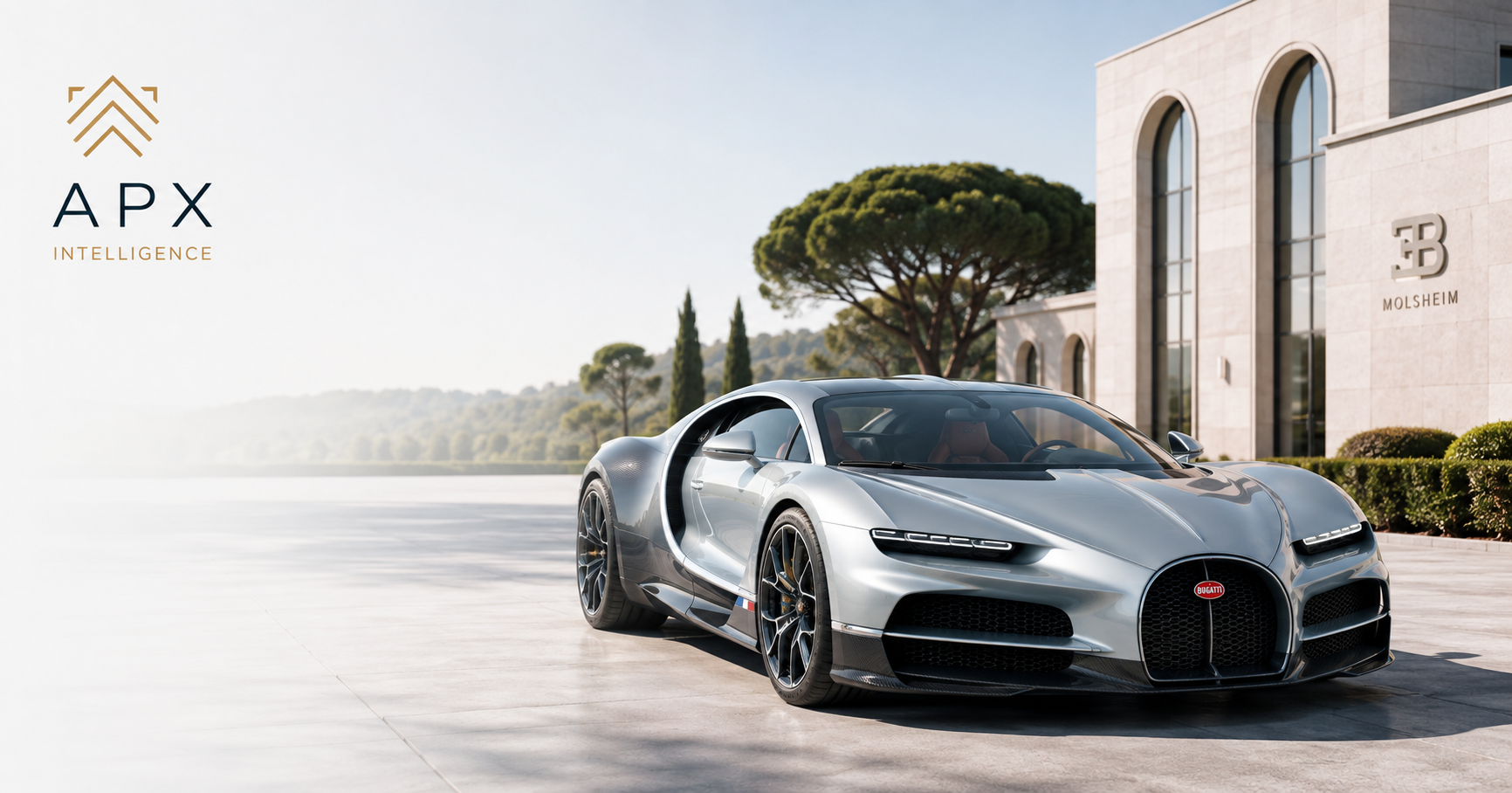
Bugatti Tourbillon: The €4 Million Collector Question
Asset, engineering landmark or long-term collector risk? APX examines the economics, technical complexity and ownership implications of Bugatti's new V16 hybrid flagship.
Executive Summary
The Bugatti Tourbillon is more than a replacement for the Chiron.
It marks a structural reset for the marque.
The W16 architecture that defined modern Bugatti has been replaced by a naturally aspirated V16 working with three electric motors to produce a combined 1,800 PS. Only 250 examples will be produced, with all production slots allocated shortly after reveal and production beginning in 2026. :contentReference[oaicite:1]{index=1}
Those facts create an obvious collector case: low production, unmistakable lineage, engineering significance and entry into a highly restricted ownership pool.
But they also introduce a different question.
The real issue is not whether the Tourbillon is significant. It is whether its technical ambition creates an equally significant long-term ownership dependency.
For collectors acquiring at multimillion-euro values, engineering importance and investment quality are not automatically the same thing.
Key Takeaways
- Bugatti will build only 250 Tourbillons, making it materially scarcer than the Chiron's 500-car production run. :contentReference[oaicite:2]{index=2}
- All 250 production slots were allocated shortly after the model was revealed. :contentReference[oaicite:3]{index=3}
- The Tourbillon produces 1,800 PS from a naturally aspirated V16 and three electric motors. :contentReference[oaicite:4]{index=4}
- Bugatti quotes 0–100 km/h in approximately 2.0 seconds and a top speed of up to 445 km/h. :contentReference[oaicite:5]{index=5}
- The car opens a new technological era for Bugatti after two decades dominated by the W16.
- Its long-term collector case will depend as much on supportability, provenance and specification as on headline performance.
- Early secondary-market premiums should be assessed against verified transaction evidence rather than advertised prices.
1. Why the Tourbillon Matters
For almost two decades, modern Bugatti was defined by the W16.
The Veyron established the architecture. The Chiron refined it. The W16 Mistral closed the chapter in 2026. :contentReference[oaicite:6]{index=6}
The Tourbillon replaces that formula entirely.
Its naturally aspirated V16 is paired with a sophisticated hybrid system, while Bugatti has redesigned the chassis, suspension, electrical architecture and cockpit around a different interpretation of what a modern hypercar should be.
That matters because collector markets often reward cars that mark clear turning points.
A significant vehicle is easier to understand decades later when it represents a recognisable before-and-after moment.
The Tourbillon has that characteristic.
It is the first modern Bugatti after the W16 era.
2. Scarcity and Allocation
Bugatti will produce only 250 examples of the Tourbillon.
That is half the planned production of the Chiron, which was capped at 500 cars. :contentReference[oaicite:7]{index=7}
More importantly, Bugatti confirmed that all 250 production positions were allocated shortly after the car's unveiling. :contentReference[oaicite:8]{index=8}
At first glance, that creates a straightforward scarcity premium.
But production volume alone does not determine collector value.
The correct question is whether the number of serious long-term buyers materially exceeds the number of cars that eventually become available.
In the primary market, Bugatti controls access.
In the secondary market, the buyer controls the clearing price.
Those two markets should not be conflated.
3. The V16 Hybrid Architecture
The Tourbillon's engineering proposition is unusual even by hypercar standards.
Its naturally aspirated V16 produces approximately 1,000 PS, while three electric motors contribute a further 800 PS for a combined 1,800 PS. :contentReference[oaicite:9]{index=9}
Bugatti quotes 0–100 km/h in approximately 2.0 seconds and a potential maximum speed of 445 km/h. :contentReference[oaicite:10]{index=10}
Yet the important collector point is not simply the output.
A naturally aspirated V16 in a production road car is itself an extraordinary engineering statement at a time when downsizing and electrification dominate mainstream automotive development.
The Tourbillon therefore combines two seemingly contradictory narratives:
- a highly traditional large-capacity combustion engine; and
- a deeply integrated modern hybrid architecture.
That contradiction may ultimately become one of its strongest historical attributes.
4. Technology as Both Asset and Liability
The sophistication that makes the Tourbillon historically important also creates long-term ownership complexity.
The vehicle depends on model-specific hybrid components, electric motors, battery architecture, electronic control systems, bespoke displays, active systems and highly specialised software.
These systems create forms of dependency that earlier analogue collector cars simply do not possess.
A future owner is therefore not merely acquiring a mechanical object.
They are acquiring continuing reliance on Bugatti's engineering, diagnostic and parts ecosystem.
For long-term collectors, the relevant question is not whether the technology works today.
It is whether the entire technical ecosystem remains supportable decades from now.
Bugatti is clearly investing in the infrastructure required for the Tourbillon era, including the new manufacturing facility in Molsheim that will become the model's production home. :contentReference[oaicite:11]{index=11}
That is encouraging, but long-term ownership should still be modelled with technical dependency in mind.
5. Price Discovery and Secondary-Market Premiums
Any newly launched limited-production hypercar attracts headline asking prices.
The Tourbillon will be no exception.
However, the same valuation rule applies here as with any thinly traded collectable asset:
an asking price is not a market price.
A dealer advertising a Tourbillon at a major premium establishes only the seller's expectation.
The strongest valuation evidence remains completed arm's-length transactions.
| Evidence | Reliability |
|---|---|
| Completed arm's-length transaction | Highest |
| Verified private transaction | High |
| Credible live bid | Moderate |
| Dealer asking price | Indicative only |
With only 250 cars globally, transaction data will remain thin.
That makes disciplined valuation more important, not less.
6. Specification and Personalisation
At this level, configuration can materially influence long-term collectability.
Bugatti's customers typically engage in highly bespoke personalisation, and the Tourbillon is being positioned as a deeply individual commission rather than a conventional series-production vehicle.
That can create value.
It can also destroy liquidity.
A configuration that is highly meaningful to the first owner may prove difficult for the second.
Collectors should therefore distinguish:
- rare specification;
- historically coherent specification;
- aesthetically transferable specification; and
- extreme personalisation.
Those categories are not interchangeable.
The more distinctive the commission, the more important it becomes to ask whether the uniqueness adds transferable collector appeal or merely reflects one individual's taste.
7. Ownership Economics
The capital required to acquire a Tourbillon is only one part of the ownership equation.
Total economic exposure may include:
- factory personalisation;
- local taxation and registration;
- specialist transport;
- insurance;
- secure climate-controlled storage;
- authorised maintenance;
- age-sensitive tyres and consumables;
- hybrid-system maintenance;
- battery monitoring and conditioning;
- software and technical campaigns;
- collection management;
- cross-border tax and customs issues;
- transaction costs on sale; and
- opportunity cost of deployed capital.
At multimillion-euro values, opportunity cost can become material.
A car that rises substantially in nominal value may still generate a modest real return once carrying costs, inflation and transaction expenses are considered.
That distinction matters for any buyer treating the Tourbillon partly as an asset rather than purely as consumption.
8. Maintenance and Factory Dependency
The Tourbillon's maintenance profile should be considered from the point of acquisition.
Bugatti has already signalled the importance of aftersales infrastructure as the company transitions from the W16 generation into the Tourbillon era. :contentReference[oaicite:12]{index=12}
For collectors, documented factory support is likely to become increasingly important over time.
Particular attention should be given to:
- high-voltage battery health;
- hybrid-system servicing;
- software history;
- factory campaigns and recalls;
- model-specific tyre availability;
- active system calibration;
- component replacement history; and
- authorised service documentation.
The Tourbillon's specially developed Michelin tyre programme itself illustrates how tightly integrated some components are with the car's performance envelope. :contentReference[oaicite:13]{index=13}
That level of specialisation can support performance.
It can also increase future replacement complexity.
9. Provenance and Due Diligence
A secondary-market Tourbillon should be treated as a high-value collectable asset rather than simply an exotic vehicle.
Due diligence should include:
Factory Build Documentation
Confirm the original configuration, factory options, bespoke personalisation and commissioning history.
Ownership Chain
Establish a complete and documented chain of title.
Service History
Verify servicing directly with authorised Bugatti channels where possible.
Accident and Repair History
Carbon structures, advanced composites and integrated aerodynamic systems require specialist inspection.
Software and Technical Status
Confirm that the vehicle is current with manufacturer campaigns and software revisions.
Tax and Customs Position
Cross-border acquisitions should be reviewed for VAT, duty, import, export and registration exposure.
Transaction Security
At these values, title verification, conditional settlement, escrow arrangements, transport insurance and governing law should be professionally structured.
10. Tourbillon vs Chiron
The Tourbillon will inevitably be compared with the Chiron.
But they represent different collector propositions.
| Factor | Chiron | Tourbillon |
|---|---|---|
| Production | 500 | 250 |
| Powertrain Era | Quad-turbo W16 | Naturally aspirated V16 hybrid |
| Collector Narrative | Ultimate development of the Veyron formula | Beginning of a completely new Bugatti era |
| Technical Complexity | Extremely high | Higher still through hybrid integration |
| Market Maturity | Established secondary market | Early price-discovery phase |
The Chiron benefits from a mature ownership history and an established collector hierarchy.
The Tourbillon does not yet.
That means early Tourbillon buyers are effectively pricing a future market that has not yet developed.
11. Liquidity and Exit
At this value level, liquidity is naturally limited.
There may be many individuals globally capable of purchasing a Tourbillon.
Far fewer will be actively seeking a specific example at a specific moment.
The exit route can therefore materially influence realised value.
| Exit Route | Advantage | Risk |
|---|---|---|
| Private Treaty | Discretion and control | Limited price discovery |
| Specialist Dealer | Access to established buyer relationships | Margin cost |
| Major Auction | Competitive tension and public transparency | Public downside if bidding disappoints |
| Off-Market Broker | Targeted qualified-buyer access | Execution quality varies materially |
A weak public sale can become a market reference point.
That makes timing particularly important where transaction volume is low.
12. Is the Bugatti Tourbillon Investment Grade?
The Tourbillon possesses many of the characteristics associated with important collector cars.
- production limited to 250 examples;
- complete allocation shortly after launch;
- clear historical importance;
- unusual V16 hybrid architecture;
- strong brand recognition;
- extreme engineering differentiation; and
- a direct position as the first model of a new Bugatti era.
Those qualities support long-term desirability.
They do not eliminate valuation risk.
A Tourbillon acquired at factory economics may represent a fundamentally different proposition from one bought at a substantial secondary-market premium.
The car can be investment grade while the transaction is not.
Frequently Asked Questions
How many Bugatti Tourbillons will be produced?
Bugatti will produce 250 Tourbillon examples at Molsheim, with production beginning in 2026. :contentReference[oaicite:14]{index=14}
How much power does the Bugatti Tourbillon produce?
The Tourbillon produces a combined 1,800 PS from its naturally aspirated V16 engine and three electric motors. :contentReference[oaicite:15]{index=15}
Is the Bugatti Tourbillon sold out?
Yes. Bugatti stated that all 250 production slots were allocated shortly after the model was revealed. :contentReference[oaicite:16]{index=16}
Is the Bugatti Tourbillon a good investment?
The Tourbillon has strong collector credentials, but investment quality will depend on acquisition price, specification, condition, ownership history, technical support, market liquidity and eventual exit timing.
Why is long-term maintenance important for the Tourbillon?
The Tourbillon combines a naturally aspirated V16 with a sophisticated high-voltage hybrid system, bespoke electronics, active systems and model-specific components, making factory support and documented maintenance central to long-term ownership.
Verification & Primary Sources
APX Perspective
The Tourbillon is almost certain to become historically important.
Its scarcity, engineering ambition and position as the first post-W16 Bugatti give it a collector narrative few modern cars can replicate.
But collectors should resist treating engineering significance as a substitute for investment discipline.
The Tourbillon's greatest strength — its extraordinary technical complexity — is also the feature most likely to shape long-term maintenance, support costs and ownership dependency.
Sophisticated buyers should therefore separate the object from the transaction.
The Tourbillon may be one of the defining cars of its era. That does not mean every price paid for one will be defensible.
APX Connect
Every valuable connection starts with a conversation.
Looking to acquire or sell a significant collector vehicle, source an off-market opportunity or speak with a specialist adviser?
APX Connect provides a confidential route for members seeking relevant introductions across the collector-vehicle ecosystem.
For dealers, brokers, marques, restorers, collection advisers and specialist automotive businesses, APX also provides a route to contribute expertise and reach a private-capital audience through relevant intelligence and opportunities.
Continue Your Journey
Discover
I want to acquire
Browse verified opportunities across collectables, aviation, marine, real estate and other high-value assets.
Present
I want to sell
Present a significant asset to a curated audience of qualified private buyers.
Connect
I need an introduction
Request a confidential introduction through APX Connect.
Contribute
I want to publish
Share specialist intelligence with APX's private-capital audience.


