
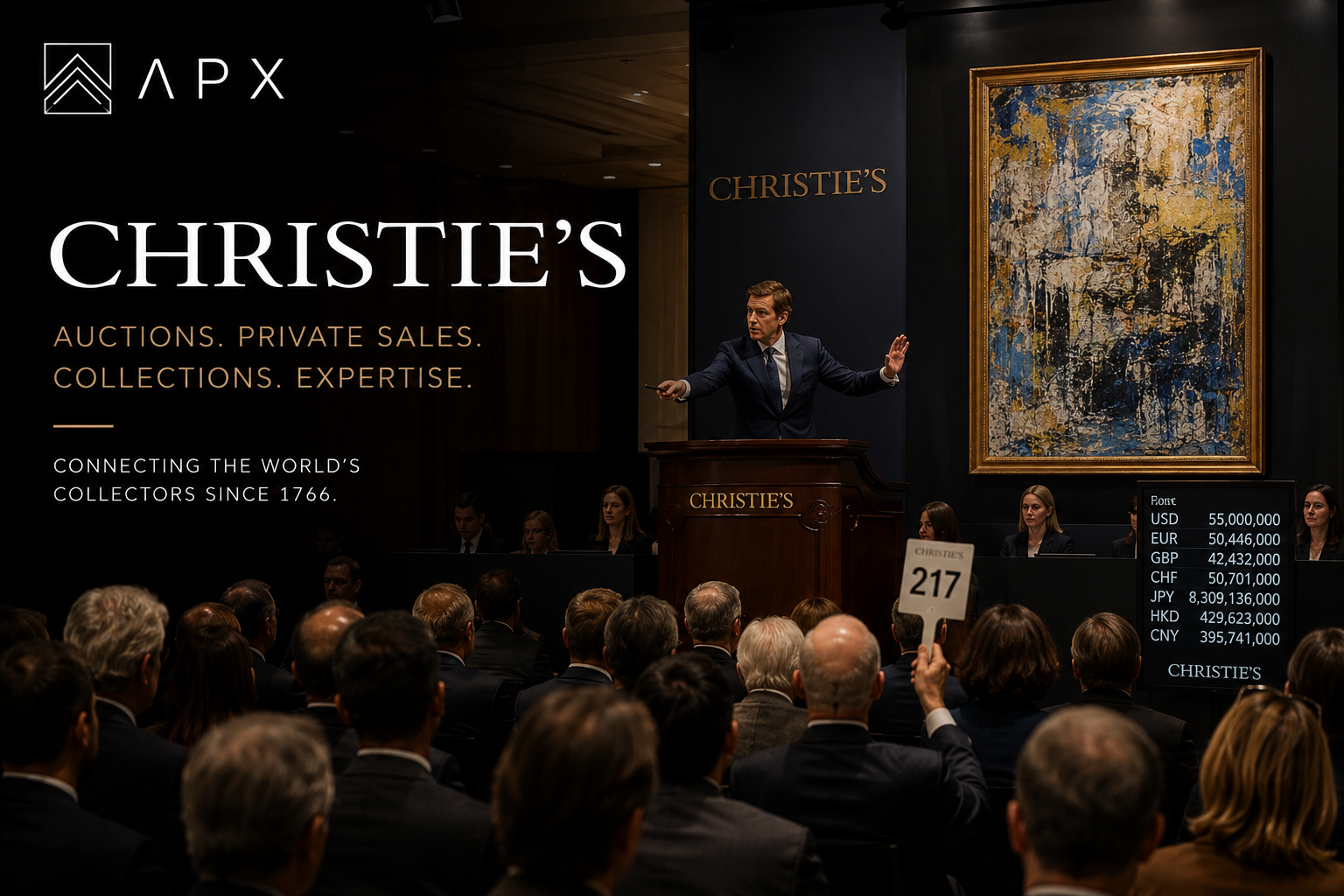
Christie’s: Inside the Global Auction House for Art, Private Sales and Collectors
How auctions, discreet private transactions, collection sales and art-backed finance connect the world’s collectors
Executive Summary
Few names have become as closely associated with the international art market as Christie’s.
Founded in 1766, the auction house now operates across fine art, antiquities, jewellery, watches, wine, design, rare books, memorabilia and other collectible categories, with flagship international salerooms in London, New York, Hong Kong, Paris and Geneva and a physical presence across almost 50 countries. Christie’s says it brings approximately 50,000 objects to market annually across more than 80 art and luxury categories.
But for serious collectors, Christie’s is no longer simply somewhere objects are placed on a podium and sold to the highest bidder.
The business now operates across several overlapping markets: highly visible live auctions, online-only sales, specialist valuations and collection strategies, Private Sales (in which an object changes hands outside the public auction process), and Christie’s Art Finance, providing qualifying collectors with loans secured against fine art and other luxury assets.
That ecosystem matters because the needs of UHNW collectors rarely begin and end with a single purchase. A collector may want to acquire privately rather than compete publicly; an estate may need to understand how an entire collection should be dispersed; a family office may want an independent valuation; or an owner may want liquidity without selling.
For APX members, Christie’s provides a useful illustration of how the upper end of the art market actually functions: public auction is only one route into the market.
Key Takeaways
- Christie’s was founded in 1766 and has developed into one of the world's major art and luxury businesses with flagship salerooms in London, New York, Hong Kong, Paris and Geneva.
- Christie’s offers approximately 50,000 objects each year across more than 80 categories.
- In the first half of 2026, Christie’s reported $3.5 billion in auction sales, up 71% year-on-year, with a 91% sell-through rate.
- Christie’s reported more than $1 billion of Private Sales in H1 2026, illustrating the significance of transactions conducted away from public auctions.
- Online auctions are increasingly important for client acquisition: Christie’s reported that online sales generated 63% of all new bidders and buyers in H1 2026.
- Christie’s Art Finance offers asset-secured lending starting at US$1 million, with typical loans around 40–60% of the low auction estimate of collateral.
- The hammer price is not the final price paid; buyer’s premium, taxes, shipping and other charges apply.
- A dedicated Private and Iconic Collections team advises on the disposal of major single-owner and multi-category holdings.
What Is Christie’s?
For the newcomer, Christie’s is an auction house. For the experienced collector, that description is incomplete.
The modern Christie’s functions more like a global marketplace and advisory infrastructure for important objects. Its specialist departments cover everything from 20th and 21st-century art, Old Masters and antiquities to jewellery, watches, wine, design, books, manuscripts and collectibles. Through Gooding Christie’s, its reach also extends into important collector automobiles.
The breadth is significant because serious collections are rarely as neat as category headings suggest. A single family estate might contain a Picasso, 18th-century furniture, contemporary sculpture, Cartier jewellery, rare watches, first-edition books, wine, and a collection of historic cars. For an adviser or family office, the ability to evaluate those objects through one network can be as important as the auction itself.
Christie’s in 2026: A Strengthening Art Market
The first half of 2026 was particularly strong for Christie’s. The company reported $3.5 billion in auction sales, representing a 71% increase from $2.1 billion in the equivalent period of 2025. Its reported auction sell-through rate increased from 87% to 91%.
Twenty-first and 20th-century art accounted for approximately $2.313 billion of first-half auction sales, while luxury generated $539 million and Asian & World Art $249 million. Classics and Old Masters also posted substantial year-on-year increases.
At the very top end, Christie’s reported selling the three highest-value works at auction during the first half of the year:
- Jackson Pollock's Number 7A, 1948: Achieved $181.2 million.
- Constantin Brancusi's Danaïde: Achieved $107.6 million.
- Mark Rothko's No. 15 (Two Greens and Red Stripe): Achieved $98.4 million.
The S.I. Newhouse collection alone generated approximately $630.8 million in May 2026.
Those headline figures naturally attract attention, but Private Sales exceeding $1 billion in the first six months of 2026 tells an even more revealing story: much of the serious art market operates through conversations long before anything becomes publicly available.
Buying at Christie’s: Auction Is Still the Theatre
The live auction remains Christie’s most recognisable environment. An object is catalogued, an estimate is published, and registered buyers compete in the room, by telephone, online or through absentee bidding until the hammer falls. Christie’s also operates online-only auctions over several days.
For a buyer, an auction creates price discovery—a defined moment in which the market decides how much it is prepared to pay. That can produce extraordinary results for exceptional works, but it can also produce opportunity. Christie’s brings objects to market from approximately $500 to above $100 million, showing how broad the client base has become.
The Estimate Is Not the Purchase Price
This is one of the most important distinctions for inexperienced auction buyers. Suppose a painting is estimated at £800,000–£1.2 million, and the winning bid is £1 million. That £1 million is the hammer price—it is not the final invoice total.
Christie’s adds a buyer's premium to successful auction purchases, alongside potential taxes, shipping, or artist resale rights. Effective from September 2025, Christie’s London buyer's-premium structure is tiered at:
- 27% on the first £1 million of hammer price;
- 22% from £1,000,001 to £6 million;
- 15% above £6 million (excluding applicable taxes).
Sophisticated bidders calculate the all-in acquisition cost, knowing that transaction friction is a fundamental part of collectible-asset economics.
The More Interesting Market: Christie’s Private Sales
Auction generates publicity; Private Sales generates discretion. Christie’s defines a Private Sale simply as a transaction it brokers in which the object does not go to auction.
For UHNW collectors, the advantages are significant: there is no public auction date, less public exposure, the ability to test a price discreetly, and an object changes hands without creating a visible price signal in the open market. More than $1 billion of Christie's sales during H1 2026 took place through Private Sales.
Why Would a Collector Sell Privately?
- Privacy: Avoids public exposure of ownership, proposed valuations, or an unsuccessful attempt to sell.
- Price Control: Offers greater negotiation around an acceptable minimum price rather than relying on auction dynamics.
- Timing: Sellers can transact immediately rather than waiting for major seasonal auction calendars in New York, London, Paris or Hong Kong.
- Targeted Buyers: Specialists can approach a small pool of known, high-intent collectors directly.
Why Would a Buyer Prefer a Private Sale?
Some buyers prefer not to compete publicly or dislike the psychology of an auction room. A buyer looking for something highly specific—a specific artist, period, size, provenance, or even a specific work—can instruct an adviser to locate the asset off-market.
Off-Market Art Is Different from Off-Market Property
Not all private artwork is strictly "off-market"—some Private Sales inventory is shown at private exhibitions or offered digitally. The crucial factor is access: a collector with the right network can inquire about works held in private collections, pieces undergoing succession planning, or assets quietly being considered for disposal before they enter the public domain.
Selling a Major Collection Is a Different Discipline
Dispersing an entire collection requires a portfolio strategy applied to cultural assets. Christie’s Private and Iconic Collections team handles major single-owner holdings, having represented collections connected to the Rockefellers, Paul G. Allen, Ann and Gordon Getty, Audrey Hepburn, Elizabeth Taylor and Yves Saint Laurent.
Structuring a collection disposal involves deciding whether to keep holdings together, split by category, sell across multiple seasons, or combine public auctions with private sales to maximize total yield.
Provenance: The Invisible Component of Value
Provenance—the documented history of an object's ownership—is a core component of asset value. An unbroken, prestigious history reinforces desirability and market value, whereas incomplete or opaque provenance introduces legal, authenticity, and cultural-property risks that can diminish value significantly.
Christie’s and Antiquities
Collecting in the Ancient Art and Antiquities category requires rigorous due diligence regarding provenance, export history, cultural-property laws, and documentation. Legal provenance and title are fundamental components of an ancient object's value and marketability.
Christie’s Art Finance: When the Collection Becomes Collateral
Christie's Art Finance provides loans secured against qualifying fine art and luxury assets. Key parameters include:
- Facility Minimum: Starting at US$1 million.
- Loan-to-Value (LTV): Typically 40–60% of the collateral's low auction estimate.
- Term Length: Generally 1 to 3 years.
This allows UHNW collectors to unlock liquidity without triggering capital gains taxes or selling prized assets, enabling capital deployment toward new acquisitions, business opportunities, or estate planning.
Custody and Storage Considerations
Christie’s generally takes possession of the pledged artwork during the loan term, though in specific jurisdictions collateral may remain with the client where legal frameworks permit. Financing options should always be evaluated on custody, insurance requirements, LTV, and repayment flexibility.
Online Bidding Has Changed Who Enters the Market
Christie’s reported that 63% of all new bidders and buyers in the first half of 2026 entered through online sales, with Millennials and Gen Z representing 47% of new clients. Digital channels serve as a primary entry point into the broader luxury and art market ecosystem.
Buying at Auction: The APX Checklist
- The Work: Evaluate quality, period, and standing within the artist's body of work.
- Provenance: Verify the ownership trail and documentation completeness.
- Condition: Examine restoration history and long-term conservation requirements.
- All-In Price: Calculate total cost including hammer price, buyer’s premium, taxes, and shipping.
- Exit Strategy: Understand secondary market liquidity and potential resale routes before committing capital.
Auction or Private Sale: Which Is Better?
- Auction is optimal when: Multiple competitive buyers exist, public price discovery is advantageous, and a defined sale date is required.
- Private Sale is optimal when: Discretion is paramount, targeted buyers are identified, or price certainty is preferred over competitive bidding.
The APX Perspective
Christie’s demonstrates how sophisticated the ecosystem surrounding physical luxury assets has become. Public auctions provide transparent price discovery, while Private Sales offer discretion and tailored negotiation. Behind both sit valuations, provenance research, and art-backed financial solutions.
Navigating this market requires collectors to look beyond immediate acquisition and consider transaction friction, financing options, custody, and long-term succession planning. Art and antiquities exist at the intersection of capital allocation, personal passion, and cultural heritage.
Frequently Asked Questions
What is Christie’s?
Christie’s is an international art and luxury business founded in 1766. It conducts live and online auctions and Private Sales across more than 80 categories, with major salerooms in London, New York, Hong Kong, Paris and Geneva.
Can anyone buy at Christie’s?
Yes. Bidders must register and complete identity and financial verification requirements prior to participating in live or online auctions.
What is the Christie’s buyer’s premium?
The buyer’s premium is a percentage fee added to the winning hammer price, tiered based on transaction value and local saleroom rules.
What is a Christie’s Private Sale?
A Private Sale is a transaction brokered privately by Christie’s specialists between a buyer and seller outside of a public auction setting.
Does Christie’s lend money against art?
Yes. Christie’s Art Finance provides asset-backed loans starting at US$1 million secured against fine art and luxury assets, typically at 40–60% LTV of the low auction estimate.
Can Christie’s manage the sale of an entire collection?
Yes. Christie’s dedicated Private and Iconic Collections team manages single-owner and multi-category collection disposals globally.


