
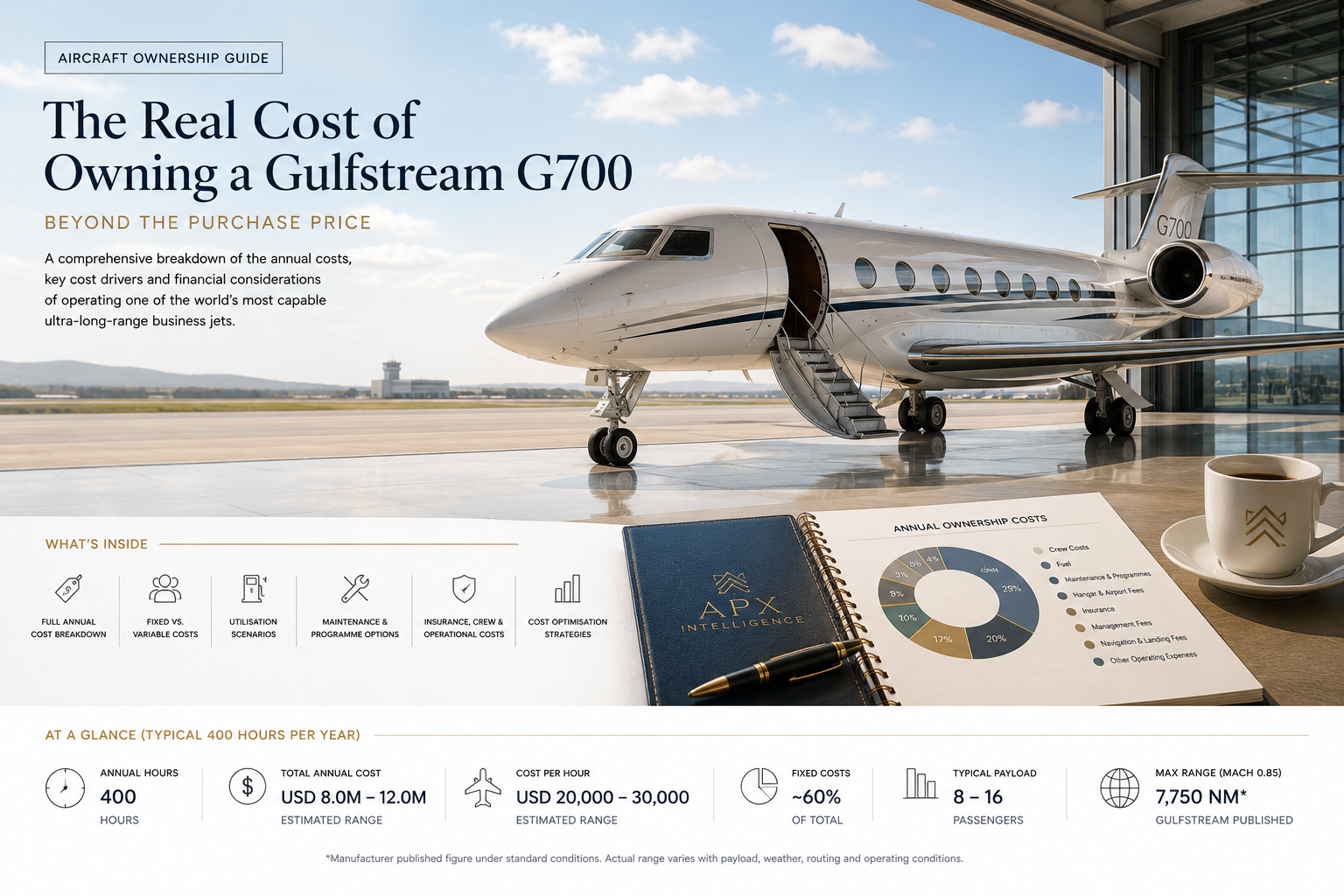
The Real Cost of Owning a Gulfstream G700: Beyond the Purchase Price
An institutional operational audit for principals, family offices, and corporate flight departments evaluating fixed overheads, direct operating costs, maintenance programs, and capital depreciation mechanics.
Executive Summary
Buying a Gulfstream G700 is one transaction. Owning one is an operating business. The distinction matters. At the highest level of private aviation, acquisition price attracts the headlines, but it is the recurring cost and operational infrastructure behind an aircraft that determine whether ownership ultimately makes sense. Crew must be recruited and retained. Pilots require recurrent training. The aircraft needs hangarage, insurance and management. Two Rolls-Royce Pearl 700 engines require an appropriate maintenance strategy. Fuel, navigation, handling and landing charges accumulate every time the aircraft moves. And when it isn't moving, many costs continue. That means asking "What does a Gulfstream G700 cost per year?" without understanding how it will be used is the wrong question. A principal flying 200 hours annually operates under completely different economics from a global family office flying 600. The more useful question is: What does a G700 cost to own for the missions we actually intend to fly—and what are we receiving in return for that expenditure?
Key Takeaways
- Infrastructure Over Asset: Acquisition cost is merely the entry point; annual fixed and variable operational infrastructure dictates true balance-sheet impact.
- Fixed Overhead Pressure: Crew salaries, simulator training, insurance, hangarage, and management retainers accumulate continuously, regardless of whether the aircraft flies 50 or 500 hours.
- Utilisation Thresholds: Low-utilisation operations (<250 hours/year) struggle to justify whole ownership over fractional or charter options on pure cost-per-hour metrics.
- Maintenance Predictability: Comprehensive engine programs (e.g., Rolls-Royce CorporateCare Enhanced) stabilize cash flows and protect secondary market residual values.
- High-Speed Operational Economics: Cruising at Mach 0.90 reduces cumulative flight hours over long distances, extending calendar inspection intervals and optimizing crew duty limits.
- Uninvoiced Costs: Capital depreciation and opportunity costs frequently exceed annual direct operating expenditures, requiring explicit pre-acquisition modeling.
- Repositioning Leakage: Non-revenue empty flight sectors consume fuel, airframe hours, and crew duties, representing a primary source of operating budget inflation.
1. Purchase Price Is Only the Beginning
The G700 sits at the flagship end of business aviation.
Gulfstream currently publishes a maximum theoretical range of 7,750 nautical miles at Mach 0.85, a high-speed range of 6,650 nm at Mach 0.90, capacity for up to 19 passengers and as many as five living areas.
Those capabilities explain why an owner might acquire one. They don't explain what happens next.
Once delivered, the aircraft effectively becomes a small aviation operation requiring people, infrastructure, regulatory oversight and continual expenditure.
$$\text{Total Ownership Cost} = \text{Capital} + \text{Fixed Costs} + \text{Variable Costs} + \text{Maintenance} + \text{Depreciation} + \text{Opportunity Cost}$$
And several of those components can exceed what first-time aircraft owners expect.
2. Fixed Costs: The Aircraft Costs Money Before It Flies
This is the first distinction every prospective owner should understand. Some costs exist largely irrespective of whether the aircraft flies 100 hours or 500.
An ultra-long-range aircraft requires appropriately qualified professional pilots. But salary is only one element. The true employment cost can include:
- remuneration;
- benefits;
- recurrent simulator training;
- medicals;
- travel;
- accommodation;
- positioning;
- uniforms;
- recruitment;
- and additional crew coverage.
Long-distance operations complicate matters further. A principal expecting near-continuous aircraft availability cannot necessarily structure the operation around the minimum number of people required to complete one flight. Availability requires redundancy.
3. Cabin Crew Is Part of the Operating Model
For shorter private flights, cabin service can sometimes be treated as optional. For a flagship aircraft operating 12- or 14-hour sectors, it becomes a very different proposition.
The cabin may contain sleeping areas, dining spaces and multiple passenger zones. Providing the experience the aircraft was designed to deliver can therefore require professional cabin personnel.
For UHNW families, there can be additional considerations around:
- discretion;
- security;
- dietary requirements;
- children;
- pets;
- medical needs;
- preferred provisioning;
- and continuity of service.
At this level, crew aren't simply employees of an aircraft. They become part of the principal's wider private infrastructure.
4. Hangarage: Geography Matters
Where will the aircraft live? That seemingly simple question can materially affect ownership cost and convenience.
Hangar availability at major business-aviation airports can be constrained and expensive. The owner's preferred base also affects:
- crew positioning;
- maintenance access;
- fuel;
- airport charges;
- ground handling;
- passenger transfer time;
- and empty repositioning.
A lower-cost base 100 miles from the principal's residence may look attractive on a spreadsheet. It becomes less attractive if the aircraft repeatedly flies empty to collect its owner.
The cheapest base isn't necessarily the cheapest operation.
5. Insurance: Protecting an Extremely Valuable Mobile Asset
Aircraft insurance depends upon far more than the model. Underwriters can consider:
- hull value;
- pilot experience;
- operating geography;
- annual utilisation;
- intended use;
- claims history;
- liability limits;
- management arrangements;
- and whether the aircraft conducts commercial operations.
A newly delivered flagship aircraft represents substantial capital moving between jurisdictions at high speed. Insurance should therefore be considered part of the aircraft's broader risk architecture—not merely another annual invoice.
6. Management: Who Actually Runs the Aircraft?
Some family offices maintain their own flight departments. Others outsource aircraft management.
A professional manager can potentially coordinate crew, maintenance, scheduling, regulatory compliance, accounting, fuel purchasing, insurance, trip support, hangarage, charter operations where applicable, and vendor relationships.
| Operating Dimension | In-House Corporate Flight Department | Professional Management Company |
|---|---|---|
| Operational Focus | 100% dedicated to the principal's schedule and privacy. | Broad fleet infrastructure, 24/7 global dispatch centers. |
| Cost Dynamics | Higher fixed overhead; full employment burden on owner. | Scale discounts on fuel, insurance, and maintenance programs. |
| Regulatory Compliance | Requires internal CAMO / IS-BAO compliance team. | Turnkey regulatory oversight and safety management systems (SMS). |
Aircraft ownership and aircraft operation are not the same skill. A principal may be entirely comfortable owning an $80 million-class aviation asset while having no desire whatsoever to become an aviation operator.
For many owners, professional management is therefore infrastructure rather than overhead.
7. Fuel: The Most Visible Variable Cost
Once the aircraft begins flying, fuel becomes one of the most obvious operating expenses. But annual fuel expenditure cannot sensibly be reduced to one universal number. It varies according to:
- annual flight hours;
- sector length;
- cruise speed;
- payload;
- weather;
- airport;
- fuel location;
- routing;
- and operational practice.
This is one reason internet searches for "Gulfstream G700 cost per hour" should be treated cautiously. There is no single cost per hour that accurately represents every owner.
A 90-minute positioning flight and a 13-hour intercontinental sector don't produce identical economics merely because the aircraft type is the same.
8. Speed Has an Economic Dimension
One interesting feature of Gulfstream's own G700 proposition is its emphasis on high-speed cruise.
The company publishes up to 6,650 nm of theoretical range at Mach 0.90 and argues that travelling faster can reduce accumulated flight hours, creating longer periods between scheduled maintenance visits and potentially leaving crews fresher.
This introduces an overlooked ownership concept: Time itself is an operating variable.
For a principal whose aircraft completes hundreds of hours annually, saving time doesn't merely improve passenger convenience. It may influence crew duty, accumulated aircraft hours, maintenance timing, aircraft availability, and ultimately the economic value delivered by the asset.
9. Maintenance: Predictability Matters More Than Cheapness
Aircraft maintenance should not be analysed simply as an annual repair budget. The more useful questions are:
- What is covered?
- What isn't?
- When will expenditure occur?
- What happens following an unscheduled event?
- How quickly can the aircraft return to service?
Gulfstream operates a worldwide support structure that includes company service centres, parts distribution, authorised facilities and predictive analytics designed to anticipate service and parts requirements.
$$\text{Real Maintenance Cost} = \text{Financial Invoice} + \text{Downtime Losses}$$
The second can be considerably more inconvenient.
10. The Pearl 700 Engine Programme
The G700 uses two Rolls-Royce Pearl 700 engines, each rated by Gulfstream at 18,250 lb of take-off thrust.
Engine maintenance represents one of the areas where sophisticated owners often seek predictability. Rolls-Royce offers its CorporateCare Enhanced aftermarket programme for the Pearl 700 and describes it as transferring maintenance risk at a predictable fixed price, with the intention of supporting residual value and aircraft liquidity.
This highlights an important principle of high-value aircraft ownership: The lowest immediate maintenance expenditure is not necessarily the lowest lifetime ownership cost.
Programme enrolment can affect not only current cash flow but the way a future buyer evaluates the aircraft.
11. Scheduled vs Unscheduled Maintenance
Scheduled maintenance can be planned. Unscheduled maintenance cannot.
That distinction matters enormously when the principal expects the aircraft to be available on demand. A technical issue might result in parts, engineering labour, travel, specialist support, additional hangar time, and potentially replacement lift.
If the owner urgently needs to travel while the G700 is unavailable, another aircraft may need to be chartered.
$$\text{Unscheduled Impact} = \text{Repair Bill} + \text{Downtime} + \text{Replacement Charter} + \text{Schedule Disruption}$$
12. Navigation, Landing and Handling Charges
International private aviation creates hundreds of smaller expenses that rarely feature in glamorous aircraft brochures. Depending upon mission and jurisdiction, these can include:
- navigation fees;
- landing fees;
- parking;
- ground handling;
- de-icing;
- permits;
- passenger charges;
- customs;
- catering delivery;
- security;
- ground power;
- lavatory service;
- and transport.
Individually, many are insignificant relative to aircraft value. Collectively, across hundreds of annual movements, they become part of the ownership budget.
13. Connectivity Has Become Essential Infrastructure
For many G700 owners, an aircraft without high-quality connectivity would fundamentally fail its mission. A principal may expect to hold video conferences, access secure corporate systems, communicate with family offices, trade, stream, and work continuously across continents.
Connectivity therefore has installation, subscription and potentially upgrade costs. But the economic calculation is unusual.
The question isn't simply what the internet connection costs. It's: What is uninterrupted connectivity worth to someone whose time may be the primary reason for owning the aircraft?
14. Catering Can Become Surprisingly Complex
Private aviation catering sounds trivial beside engines and maintenance. It isn't always.
UHNW operations can involve highly specific passenger requirements and expensive airport catering environments. A family office might require:
- particular brands;
- specialist dietary preparation;
- children's meals;
- fresh produce;
- restaurant collections;
- specific wines;
- medical diets;
- pet requirements;
- or provisioning across multiple destinations.
No single catering line item will determine whether someone can afford a G700. But the category illustrates a broader truth: A private aircraft is ultimately a service operation built around its passengers.
15. Repositioning: The Cost of Flying Nobody
Empty sectors deserve much more attention in ownership analysis.
Suppose the aircraft drops the principal in New York. The next required departure is from London. What happens to the aircraft between those missions? Or the family flies outbound together but returns on different dates? Or the aircraft needs to reposition to a maintenance facility?
Empty movements consume fuel, crew time, maintenance hours, landing fees, navigation charges, and aircraft life.
A prospective owner should therefore model not merely passenger flight hours but total aircraft utilisation. The difference can be substantial.
16. The 200-Hour Owner
Now the economics become interesting. Imagine a principal expects approximately 200 hours of annual flying.
Many fixed expenses remain regardless. Crew still need paying, the aircraft still needs insurance, it still requires hangarage, management continues, and training continues.
That means fixed costs are distributed across relatively few passenger hours. At this utilisation level, the family office should seriously compare ownership with:
- charter;
- jet cards;
- fractional programmes;
- or hybrid solutions.
Ownership may still win. But the reason may be control and availability, rather than lowest cost.
17. The 400-Hour Owner
At approximately 400 annual hours, the equation changes.
The aircraft is now a heavily used mobility asset. Fixed expenses are spread across more utilisation, schedule control becomes more valuable, consistency of crew and cabin becomes increasingly useful, and security protocols become repeatable.
The principal can essentially create a private transport environment that moves with them. This is where comparing ownership purely against an hourly charter rate becomes increasingly simplistic.
18. The 600-Hour Owner
At 600 hours or more, the aircraft is operating intensively.
Now operational sophistication becomes critical. Maintenance needs careful scheduling, crew coverage becomes more demanding, duty limitations matter, downtime becomes expensive, repositioning needs optimisation, and reliability becomes fundamental.
The aircraft may absolutely justify its existence—but it increasingly resembles a serious corporate flight operation rather than a luxury possession.
19. Should You Charter the G700 When You're Not Using It?
The obvious argument is attractive: If the aircraft is sitting idle, make it earn money. Third-party charter may offset some ownership expense.
But there is no free revenue. Commercial utilisation can add hours, cycles, maintenance, cabin wear, crew workload, cleaning, scheduling conflicts, and regulatory complexity.
More importantly, it can undermine the very benefit for which some principals bought the aircraft: immediate availability.
A family office should therefore ask whether charter revenue is genuinely part of the ownership strategy—or simply an attempt to rationalise an aircraft whose utilisation does not justify the acquisition.
20. Depreciation: The Cost That Doesn't Arrive as an Invoice
This may be the most overlooked ownership expense.
An owner sees fuel invoices, crew payroll is visible, and maintenance bills arrive. Depreciation doesn't.
Yet the difference between what was paid for the aircraft and what it is eventually sold for can represent a very substantial economic cost. Residual value can be influenced by:
- age;
- flight hours;
- cycles;
- maintenance condition;
- engine programme status;
- cabin specification;
- connectivity;
- damage history;
- market supply;
- competing aircraft;
- and broader economic conditions.
An aircraft can therefore have excellent operating economics and still produce disappointing overall ownership economics if the exit value is poor.
21. Specification Is an Investment Decision
A new G700 can be configured around the commissioning owner's preferences. That freedom is valuable. But highly individual choices can affect the future market.
An interior designed around one person's unusual tastes may eventually require significant refurbishment before resale.
Conversely, a sophisticated specification incorporating desirable cabin zones, connectivity, crew facilities and broadly attractive finishes may help future marketability.
The owner shouldImpliedly decide consciously: Are we optimising entirely for ourselves—or partially for the next owner?
22. Don't Forget the Cost of Capital
Suppose tens of millions of dollars are tied up in the aircraft. That capital could otherwise be invested.
This creates an opportunity cost even where the aircraft is purchased entirely with cash. Financing introduces another layer:
- interest;
- arrangement fees;
- covenants;
- loan-to-value requirements;
- and refinancing risk.
The sophisticated ownership calculation should look beyond operating expenditure. It should consider the aircraft as a capital allocation decision.
23. So What Does a G700 Really Cost Per Year?
This is where APX deliberately resists publishing one seductive number. Any estimate without assumptions can be misleading.
The correct model synthesises three core cost tiers:
| Cost Tier | Component Line Items |
|---|---|
| Tier 1: Fixed Overhead | Crew salaries, recurrent training, hull & liability insurance, hangar base fees, management retainers, software subscriptions. |
| Tier 2: Direct Variable Costs | Jet-A fuel, engine hourly reserves, landing/handling fees, navigation charges, catering, repositioning hours, de-icing. |
| Tier 3: Capital & Asset Costs | Debt service interest, un-invoiced market depreciation, opportunity cost of equity, refurbishment reserves. |
Only after applying the owner's actual base, destinations, annual hours, passenger profile, and operating structure does an annual ownership figure become meaningful.
24. The Question Isn't Whether You Can Afford It
For a genuine G700 buyer, affordability may not be particularly interesting. The more sophisticated question is: Does ownership create sufficient utility to justify the capital and complexity?
| Utility Dimension | Operational Value Delivered |
|---|---|
| Schedule & Route Control | Bypasses commercial hub delays; grants direct access to unserved regional airfields. |
| Security & Privacy | 100% control over onboard environment, non-attributable transit, and pre-vetted crew. |
| Time Compression | Mach 0.90 cruise capability saves tens of flight hours per year, extending principal productivity. |
Those benefits are difficult to price. But they are the reason private aircraft exist.
25. The APX G700 Ownership Checklist
Before acquisition, family office boards should mandate answers to twelve operational items:
- 1. How many hours did the principal actually fly during each of the previous three years?
- 2. How many of those flights genuinely required a G700-class aircraft?
- 3. Which ten city pairs dominate travel?
- 4. How many empty positioning hours should be expected?
- 5. Where will the aircraft be based?
- 6. Who will manage it?
- 7. How will the crew structure work?
- 8. Which maintenance programmes will be used?
- 9. Will third-party charter be permitted?
- 10. How much downtime is acceptable?
- 11. How important is resale flexibility?
- 12. What is the intended ownership period?
And finally: Are we purchasing transportation—or an entire private aviation capability? Because the G700 is the latter.
26. Frequently Asked Questions
Q: What is the Gulfstream G700's range?
A: Gulfstream currently publishes a theoretical maximum range of 7,750 nautical miles at Mach 0.85, subject to its stated assumptions and real-world variables including routing, weather and outfitting.
Q: What engines does the G700 use?
A: The G700 uses two Rolls-Royce Pearl 700 engines. Rolls-Royce says the engine was specifically designed for the G700 and G800.
Q: How much does a Gulfstream G700 cost to operate per hour?
A: There is no single universally applicable figure. Fuel prices, utilisation, maintenance arrangements, crew structure, location, management and the treatment of fixed and capital costs can produce materially different results.
Q: Is owning cheaper than chartering?
A: Not necessarily. Low-utilisation owners can face substantial fixed costs per passenger hour. Ownership can nevertheless be preferable where availability, privacy, security, cabin consistency and schedule control have exceptional value.
Q: Can a G700 be chartered when the owner isn't using it?
A: Commercial operation may be possible subject to aircraft structure, operator, jurisdiction and applicable regulations. Owners should model the additional utilisation, maintenance, availability and tax consequences before relying on charter income.
Q: Does an engine maintenance programme matter at resale?
A: It can. Rolls-Royce states that its CorporateCare Enhanced programme is intended to provide predictable maintenance risk coverage while supporting residual value and liquidity.
27. Institutional Glossary
- Fixed Operating Costs
- Expenses that occur regardless of annual flight hours, including flight crew salaries, insurance premiums, hangarage, and management retainers.
- Direct Operating Costs (DOC)
- Variable hourly expenses directly triggered by flight activity, such as Jet-A fuel, landing fees, handling, navigation charges, and engine hourly reserves.
- Engine Maintenance Program
- Hourly, per-flight-hour contractual coverage (e.g., Rolls-Royce CorporateCare Enhanced) protecting against major engine overhaul expenses and preserving residual asset value.
- Empty Repositioning Legs
- Non-revenue flight sectors flown to position the aircraft or crew for the principal's next scheduled departure point.
- Depreciation & Capital Opportunity Cost
- The un-invoiced loss of asset market value over time combined with the foregone return on the capital deployed to acquire the aircraft.
28. Institutional Verification & Operational Standards
For family office aviation leads, corporate flight departments, and aircraft buyers, operational cost modeling should be cross-referenced against established industry standards:
| Governance Dimension | Governing Body / Regulatory Standard | Primary Standard & Verification Protocol |
|---|---|---|
| Flight Operations & Audit | NBAA / IS-BAO International Standards | IS-BAO Stage I-III Operating Audit Standards for Whole-Aircraft Management. |
| Engine Maintenance Coverage | Rolls-Royce CorporateCare / EASA Part 145 | Power-by-the-Hour (PBTH) Contractual Maintenance Risk Transfer Protocols. |
| Asset Depreciation Accounting | ISTAT / International Accounting Standards (IAS 16) | Property, Plant & Equipment Residual Value & Depreciation Audit Guidelines. |
29. The APX Perspective
The economics of flagship aircraft ownership are often misunderstood because people begin with the wrong number: purchase price.
The purchase price tells you what it costs to acquire the asset. It doesn't tell you what it costs to create the capability.
A G700 requires pilots, support, maintenance, fuel, hangarage, insurance, planning and capital. In return, it can create something difficult to replicate through conventional transport: a controlled, private, intercontinental mobility infrastructure built around one principal or family.
For some owners, that capability is unnecessary. For others, it can be extraordinarily valuable.
The correct ownership calculation therefore isn't: How much does the aircraft cost per hour?
It is: What does our entire aviation system cost—and what is the economic and personal value of the time, privacy, security and control it gives us?
That is the number sophisticated buyers should understand before signing the purchase agreement.


