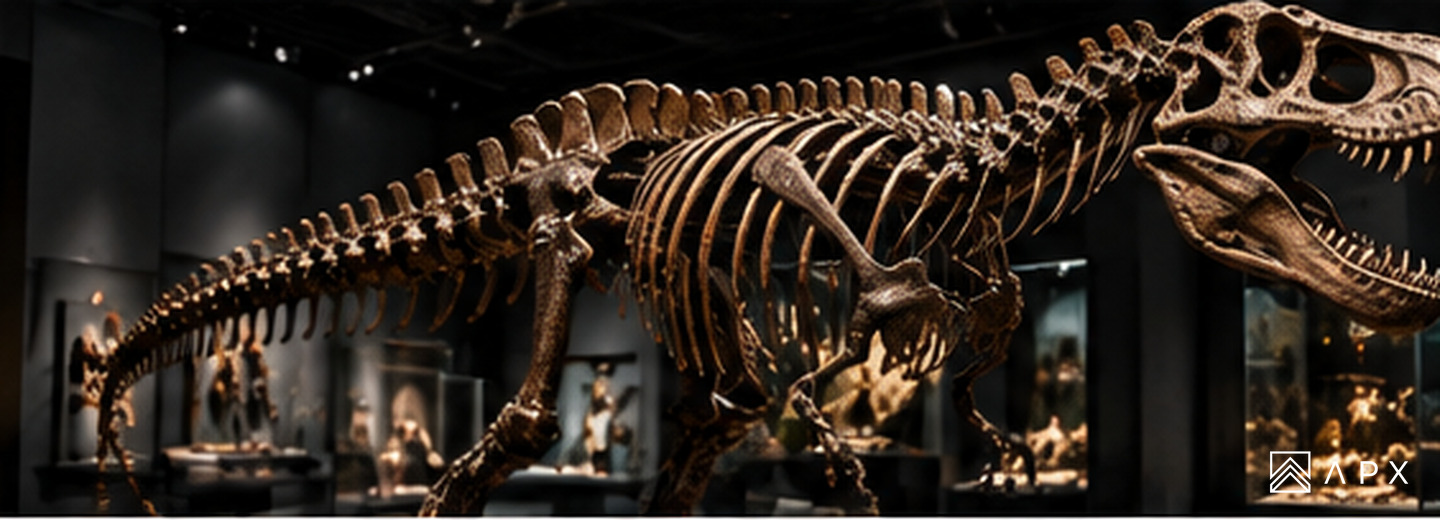
Gus the T. rex sold for $50.13 million in 2026. APX examines fossil valuation, legal provenance, completeness, scientific access and custody risk.
Executive Summary
Natural-history trophies have moved into a price range once reserved for major art. In July 2026, Sotheby’s sold 'Gus', a mounted Tyrannosaurus rex skeleton, for $50.13 million, setting a new auction record for a dinosaur. The result surpassed the $44.6 million achieved by the Stegosaurus 'Apex' in 2024 and demonstrated that exceptional fossils can attract global bidding at the very top of the collectibles market.
Fossils are also among the most complex alternative assets to diligence. Scientific completeness, reconstruction, legal excavation, land ownership, export rules, preparation quality and museum sensitivity all affect value and saleability. A dramatic skeleton may contain substantial cast or sculpted material, while a less visually complete specimen can have greater scientific integrity.
Key Takeaways
- 'Gus' sold for $50.13 million at Sotheby’s in July 2026, a world auction record for a dinosaur.
- 'Apex' the Stegosaurus sold for $44.6 million in 2024.
- Completeness, bone mass, preservation quality and documentation are central to valuation.
- Legal provenance is unusually important because excavation, land title, export and cultural-property rules can affect ownership.
- Private ownership of major fossils can attract scientific and reputational scrutiny, particularly when specimens become inaccessible to researchers.
Why Fossils Have Become Trophy Assets
Dinosaurs have global recognition that crosses age, language and collecting culture. A T. rex skeleton is simultaneously natural history, sculpture, science and spectacle. That broad emotional appeal expands the buyer pool beyond specialist palaeontology collectors to museums, foundations and UHNW individuals.
The market is also genuinely supply-constrained. Complete large dinosaurs are rare, excavation is expensive and preparation can take years. Sotheby’s said Gus took five years in the making and was among the most complete T. rex specimens sold. That combination of rarity and scale makes each top-tier skeleton more comparable to a unique artwork than to a repeatable commodity.
How to Assess a Major Fossil
Completeness and original bone
A mounted skeleton should be analysed bone by bone. Buyers need to know the percentage of original fossil material, which elements are casts, how composite material was used and whether multiple individuals contributed to the mount. Headline completeness percentages can be calculated in different ways, so methodology matters.
Excavation and legal title
Where was the fossil found, on whose land, under what rights, and can those rights be documented? Was export lawful? Were all permits obtained? The answers can determine whether the specimen can move across borders or be resold to an institution.
Preparation quality
Aggressive reconstruction can create a visually impressive object but reduce scientific value. At the best end of the market, preparation notes, excavation photographs, field jackets, mapping and conservation records should form a permanent archive with the specimen.
Liquidity, Custody and Reputation
A large fossil is expensive to move, install and insure. Buyers should plan for structural engineering, specialist rigging, environmental control and emergency procedures. Unlike a painting, a mounted skeleton may require substantial architecture around it.
There is also a public-interest dimension. Significant fossils can generate criticism if removed permanently from scientific access. Some private buyers address this through museum loans, research access or eventual donation. Those choices can become part of the object's reputation and, potentially, its future provenance.
APX Perspective
The $50 million Gus result confirms that natural history now has a true trophy tier. But this is not a market where visual impact alone is enough. The best acquisitions combine legal certainty, scientific documentation, exceptional completeness and responsible stewardship. For family offices, the acquisition process should involve palaeontological, legal, insurance and logistics specialists before bidding begins.
Frequently Asked Questions
Why are some dinosaur fossils worth tens of millions?
Exceptional species recognition, completeness, preservation, size, legal provenance and uniqueness can attract competition from museums and UHNW collectors.
Can fossils be moved internationally?
Sometimes, but rules vary by origin, excavation history and destination. Export restrictions and cultural-property laws should be checked before acquisition.
Does a mounted skeleton contain only original fossil bone?
Not necessarily. Cast, reconstructed or sculpted elements are common. Buyers should obtain a detailed inventory showing original and reconstructed components.
Related APX Intelligence
Sources & Further Reading
APX Intelligence is provided for general information only and does not constitute investment, legal, tax or financial advice. Collectibles and alternative assets can be illiquid, difficult to value and subject to material transaction, storage, insurance and authenticity risk.