
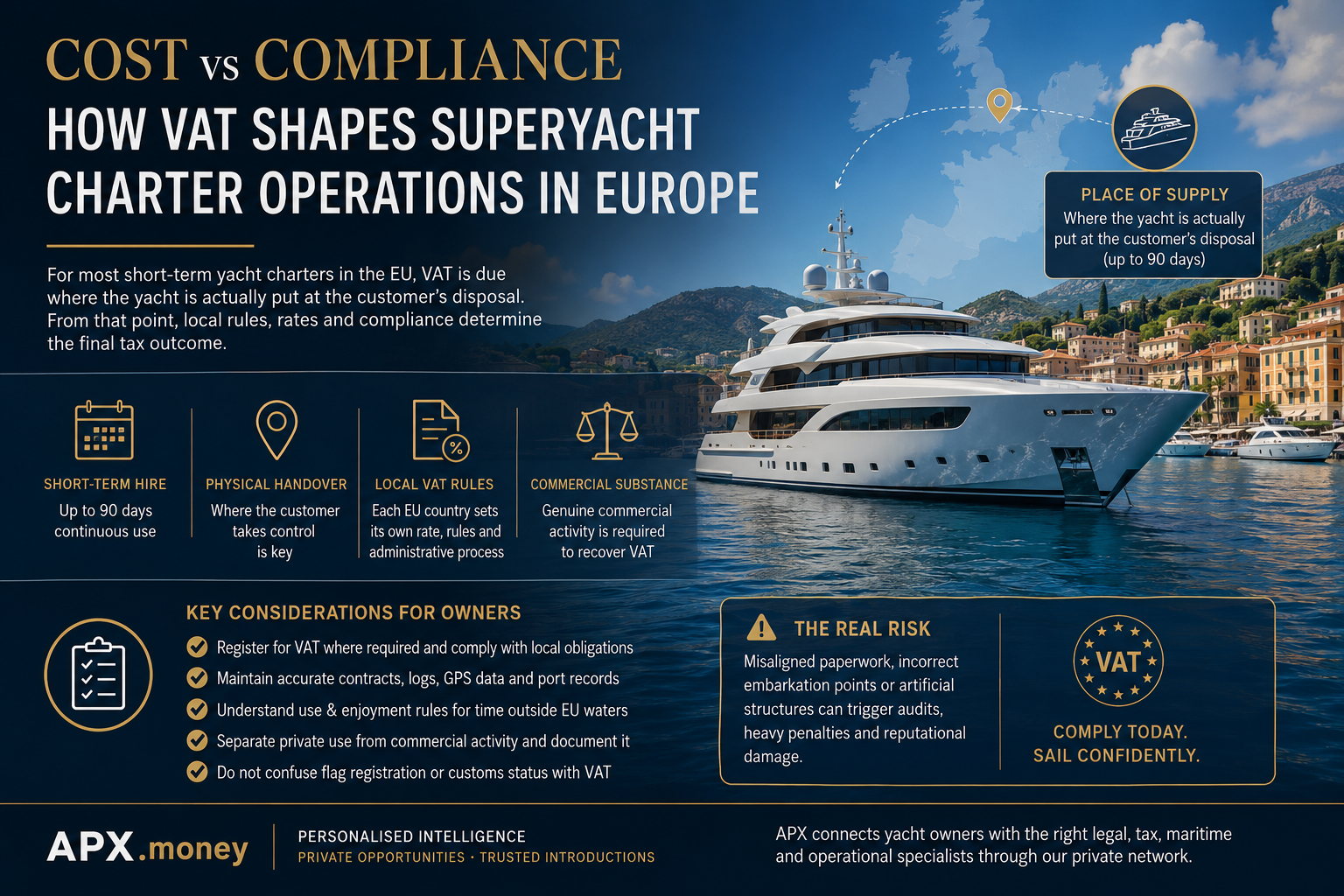
Cost vs Compliance: How VAT Shapes Superyacht Charter Operations in European Waters
For commercially operated superyachts, VAT is not simply an accounting issue. Charter duration, where guests take possession of the yacht, local implementation and the commercial substance of the operating structure can all affect the tax and compliance outcome.
Executive Summary
Many superyacht owners make their vessels available for charter to generate income and offset part of the operating cost of ownership.
That decision also changes the yacht's regulatory and tax environment.
For EU VAT purposes, the central rule for most conventional short-term yacht charters is relatively clear: where continuous possession or use does not exceed 90 days, the place of supply is generally where the yacht is actually put at the customer's disposal.
The complexity begins after that point.
Each jurisdiction applies its own VAT rate, administrative rules, registration requirements and, in some cases, rules concerning effective use and enjoyment outside its territory.
Commercial-yacht owners must also distinguish between:
- charter VAT charged to the client;
- input VAT recovery by the operating entity;
- commercial registration and flag-state requirements;
- EU customs or Union status;
- fuel and provisioning exemptions;
- private use by the beneficial owner.
The real compliance risk arises when these separate concepts are treated as though they are one tax regime.
Key Takeaways
- 90 days is the key EU definition: vessel hire of no more than 90 days is treated as short-term for the place-of-supply rules.
- Physical handover matters: the relevant place for short-term hire is where the customer or their representative actually takes physical possession of the yacht.
- Flag is not the VAT driver: a Cayman, Maltese or Marshall Islands yacht can potentially incur the same local charter VAT where the place-of-supply conditions are identical.
- National rules still matter: EU law determines the framework, but the VAT rate, reporting process and any use-and-enjoyment adjustment depend on national implementation.
- Commercial registration does not itself create VAT recovery: input VAT recovery depends on genuine taxable business activity and the use to which costs are put.
- Private use needs careful treatment: owner use within a commercial structure can create VAT, benefit-in-kind or other tax consequences depending on jurisdiction and structure.
- Route planning should follow the law, not drive an artificial arrangement: contractual embarkation points should reflect the real transaction and actual physical delivery of the yacht.
1. Why VAT Matters to Yacht Charter
A substantial yacht can generate significant annual expenditure whether it is chartered or not.
Crew, maintenance, insurance, berthing, management, class work, fuel and periodic refit all continue to create carrying cost.
Charter can offset part of that expenditure.
But once the yacht is commercially hired to clients, the operating entity becomes part of a taxable supply chain.
Charter VAT therefore affects:
- the gross price presented to the charterer;
- the yacht's competitiveness against alternatives embarking elsewhere;
- invoicing;
- VAT reporting;
- cash flow;
- input-tax recovery;
- the documentation retained by the owner and manager.
The larger the charter fee, the more material the tax becomes.
2. The Core EU Place-of-Supply Rule
Article 56 of the EU VAT Directive establishes the starting point for short-term hiring of means of transport.
For short-term hire, the place of supply is:
the place where the means of transport is actually put at the disposal of the customer.
For vessels, short-term means continuous possession or use for no more than 90 days.
In a conventional one-week superyacht charter, the place where the client takes control of the yacht is therefore normally central to the VAT analysis. :contentReference[oaicite:1]{index=1}
This is more precise than simply saying:
“VAT applies where the charter starts.”
In practical terms those may often be the same location, but legally the issue is where the yacht is actually made available to the customer.
3. Why the 90-Day Definition Matters
Yacht charters receive a longer short-term threshold than most other means of transport.
Under the VAT Directive:
- most transport is short-term for no more than 30 days;
- vessels are short-term for no more than 90 days.
Once the continuous possession or use exceeds 90 days, different place-of-supply rules can become relevant.
The contractual duration is important, but EU implementing rules also allow the actual facts to be considered, and consecutive contracts involving the same parties can potentially be aggregated where appropriate. :contentReference[oaicite:2]{index=2}
That is particularly relevant to seasonal arrangements that might otherwise appear to be a series of separate short contracts.
4. What Does “Put at the Disposal” Mean?
EU implementing rules clarify that the relevant place is where the customer, or a third party acting on their behalf, takes physical possession of the means of transport. :contentReference[oaicite:3]{index=3}
That matters because contractual wording alone should not be used to manufacture a tax outcome that differs from what actually happened.
If a charter agreement names one port but the guests actually take possession of the yacht elsewhere, the factual handover can become critical.
Relevant evidence may include:
- charter agreement;
- delivery and redelivery provisions;
- crew logs;
- passenger embarkation records;
- port documentation;
- AIS/GPS records;
- invoices;
- agent documentation.
5. Why EU Countries Can Produce Different Outcomes
The VAT Directive sets the framework, but national governments administer and collect VAT.
This means that once the place of supply has been identified, the operator must consider the relevant Member State's rules.
Differences can include:
- standard VAT rate;
- use-and-enjoyment provisions;
- charter licensing;
- VAT registration procedure;
- filing frequency;
- invoice format;
- evidence required for any reduction or adjustment;
- treatment of supplies made to taxable versus non-taxable customers.
This is why a table stating simply that “Italy is X%, Greece is Y%, Croatia is Z%” can be dangerously incomplete.
The headline rate is only one part of the analysis.
6. International Waters and Use & Enjoyment
EU law allows Member States, in certain circumstances, to adjust the place of taxation to reflect where a service is effectively used and enjoyed, in order to avoid double taxation, non-taxation or distortion of competition. :contentReference[oaicite:4]{index=4}
Yacht charter advisers sometimes describe this loosely as a discount for time spent outside EU waters.
That is too broad.
Whether an adjustment is available depends upon the national implementation and the precise facts.
Evidence can be important.
French tax guidance, for example, explicitly recognises navigation records, logbooks, GPS data and AIS information as forms of evidence when determining qualifying navigation outside French territorial waters for certain maritime VAT exemptions. :contentReference[oaicite:5]{index=5}
The broader lesson for charter operators is clear:
where VAT treatment depends upon where the yacht actually travels, the voyage needs to be capable of being proved.
7. VAT Registration and Local Compliance
A foreign yacht-owning or operating entity should not assume that one VAT registration automatically covers every European charter programme.
Where a supply is taxable in another Member State, local registration or another permitted reporting mechanism may be required depending on the particular transaction and customer.
French tax guidance, for example, states that where a supplier provides taxable services to a non-taxable customer in another EU Member State, the supplier may be required to register in the Member State where the VAT is applicable. :contentReference[oaicite:6]{index=6}
For yacht operations, the compliance review should normally establish:
- who is legally supplying the charter;
- whether that entity is established in the EU;
- whether it has a fixed establishment;
- whether the charterer is taxable or non-taxable;
- where the yacht is put at the customer's disposal;
- what VAT registrations are already held;
- what local filing obligations arise.
8. Recovering VAT on Yacht Costs
The potential recovery of VAT is one reason owners consider commercial operation.
But the principle should be expressed carefully.
VAT recovery generally depends upon the taxable person's economic activity and whether the relevant expenditure is used for taxable business purposes.
Depending on structure and jurisdiction, recoverable expenditure might potentially include VAT incurred on:
- acquisition or import;
- refit;
- repairs;
- professional services;
- management;
- certain operating expenses.
But private or non-business use can restrict recovery or create subsequent adjustment consequences.
Commercial registration is evidence of operating status. It is not itself proof that every VAT cost is recoverable.
9. Commercial Substance and Owner Use
The most sensitive structures are those in which a yacht is presented as a commercial asset while remaining, in substance, primarily available to its beneficial owner.
Tax authorities can examine the real economic activity rather than simply the corporate documents.
Relevant questions can include:
- Is the yacht genuinely marketed to third-party charterers?
- Are third-party charters actually completed?
- Are charter rates commercially credible?
- Is the owner charged appropriately when using the yacht?
- Are accounts and VAT returns consistent with the stated commercial model?
- Are private and commercial periods properly documented?
The purpose is not to suggest that owner use is prohibited.
It is to recognise that owner use inside a commercial structure must be accounted for correctly rather than ignored.
10. Fuel, Provisioning and Commercial Exemptions
Another common oversimplification is that commercially registered yachts automatically receive VAT-free fuel and provisioning.
Maritime exemptions are generally conditional.
France illustrates the point clearly.
French guidance requires qualifying vessels seeking certain maritime VAT exemptions to satisfy conditions including commercial registration, permanent crew, commercial use and a navigation test requiring at least 70% of qualifying navigation outside French territorial waters. :contentReference[oaicite:7]{index=7}
Other jurisdictions apply their own conditions.
The phrase:
“commercial yacht = tax-free fuel”
is therefore not a safe operating assumption.
11. Flag, Union Status and Charter VAT Are Separate
A yacht's European tax position can involve several distinct layers at once.
| Issue | What It Determines |
|---|---|
| Flag Registration | The yacht's nationality and flag-state regulatory framework. |
| Customs / Union Status | How the yacht is treated when moving within or entering EU customs territory. |
| Charter VAT | The VAT treatment of the charter service supplied to the customer. |
| Commercial Status | Whether the yacht complies with the technical and regulatory requirements applicable to commercial operation. |
These layers interact.
They should never be treated as interchangeable.
12. Charter Planning Without Artificiality
There is nothing inherently inappropriate about planning charter operations around tax and regulatory requirements.
Businesses routinely consider tax when deciding where and how transactions occur.
The important distinction is between:
structuring a genuine transaction efficiently
and
creating paperwork that does not reflect the real transaction.
If guests genuinely embark in one jurisdiction because that forms part of the intended charter itinerary, the applicable place-of-supply rules follow the real facts.
If documentation is manipulated to show a handover that never occurred, the structure becomes much harder to defend.
Operational planning should therefore involve:
- charter broker;
- yacht manager;
- captain;
- VAT adviser;
- maritime lawyer where necessary;
- local charter agent.
13. APX Charter VAT Framework: Ten Questions Before the Season Starts
- Who is supplying the charter? Identify the taxable entity before anything else.
- Is the charter short-term or long-term? For vessels, the 90-day threshold matters.
- Where will the client physically take possession? Do not rely solely on the contract heading.
- Which country's VAT rules therefore apply? Confirm the current local implementation.
- Does that jurisdiction apply an effective-use-and-enjoyment rule? If so, establish exactly how it works.
- What evidence must be retained? Logs, GPS data, charter agreements and port records may all become relevant.
- Does the supplier need a local VAT registration? Establish this before the charter begins.
- Is input VAT being recovered? Confirm the extent to which costs genuinely relate to taxable commercial activity.
- How is owner use treated? Private use should be explicitly documented and accounted for.
- Are customs, flag and charter VAT being confused? Review each as a separate legal question.
14. Frequently Asked Questions
Where is VAT due on a short-term yacht charter in the EU?
For short-term hiring of a vessel, meaning continuous possession or use for no more than 90 days, EU VAT rules generally place the supply where the yacht is actually put at the customer's disposal. The national VAT rules of that jurisdiction then determine how the charter is taxed.
Does the yacht's flag determine which country's VAT applies to a charter?
No. Flag registration and charter VAT are separate issues. For a short-term charter, the place where the yacht is put at the customer's disposal is generally the starting point for determining the place of supply.
Can time spent outside EU waters reduce VAT on a yacht charter?
Potentially, but only where the relevant national rules permit an effective-use-and-enjoyment adjustment or similar treatment. The methodology and evidence requirements vary by jurisdiction, so the route should not be assumed to generate an automatic reduction.
Can a yacht owner recover VAT on the purchase or running costs of a commercial yacht?
Potentially, where the owning or operating entity is carrying on genuine taxable commercial activity and the relevant input VAT is properly attributable to that activity. Recovery is not automatic and can be restricted where private use, exempt activity or non-business use is present.
Does commercial yacht registration automatically create VAT advantages?
No. Commercial registration can be relevant to the operating model, but VAT treatment depends on the actual taxable activity, ownership structure, use of the yacht, local law and supporting documentation. Commercial status should not be treated as a stand-alone tax exemption.
Verification & Official Sources
- European Commission — VAT Place of Taxation: short-term hiring of means of transport and the 90-day vessel definition.
- EU VAT Directive 2006/112/EC, Article 56: place of supply for short-term and long-term hiring of means of transport.
- Council Implementing Regulation 282/2011: interpretation of continuous possession and the place where the customer takes physical possession.
- French Tax Administration / BOFiP: current maritime VAT exemption and navigation-evidence requirements.
15. The APX Perspective
The most important thing about European charter VAT is that the headline rate is rarely the whole story.
The legal analysis begins with the nature and duration of the charter, then moves to where the yacht is physically placed at the customer's disposal, and only then into the national VAT rules of the relevant jurisdiction.
For owners, this makes VAT an operational discipline rather than a year-end accounting exercise.
Contracts, crew records, itineraries, invoices, VAT registrations and physical movements need to tell the same story.
The strongest charter structure is not the one that produces the lowest theoretical tax rate. It is the one whose commercial, contractual and physical reality remain aligned when someone eventually asks for the evidence.
APX Connect
Reviewing a European charter programme, VAT registration structure or the commercial status of a superyacht?
APX members can use APX Connect to request confidential introductions to relevant yacht managers, VAT and customs advisers, maritime lawyers, brokers and other specialist network participants. Requests are reviewed by APX before an introduction is made.
For yacht and tax specialists: APX also works with professional contributors seeking to share specialist intelligence and expertise with a curated private network.
Continue Your Journey
I Want to Acquire
Explore selected yacht opportunities available through the APX network.
Browse ListingsI Want to Sell
Present a yacht or specialist asset to relevant members through APX.
Partner With APXI Need an Introduction
Request a confidential connection to an appropriate maritime, VAT or customs specialist.
APX ConnectI Want to Publish
Share specialist yacht, VAT or maritime intelligence with the APX network.
Become an APX Partner


