
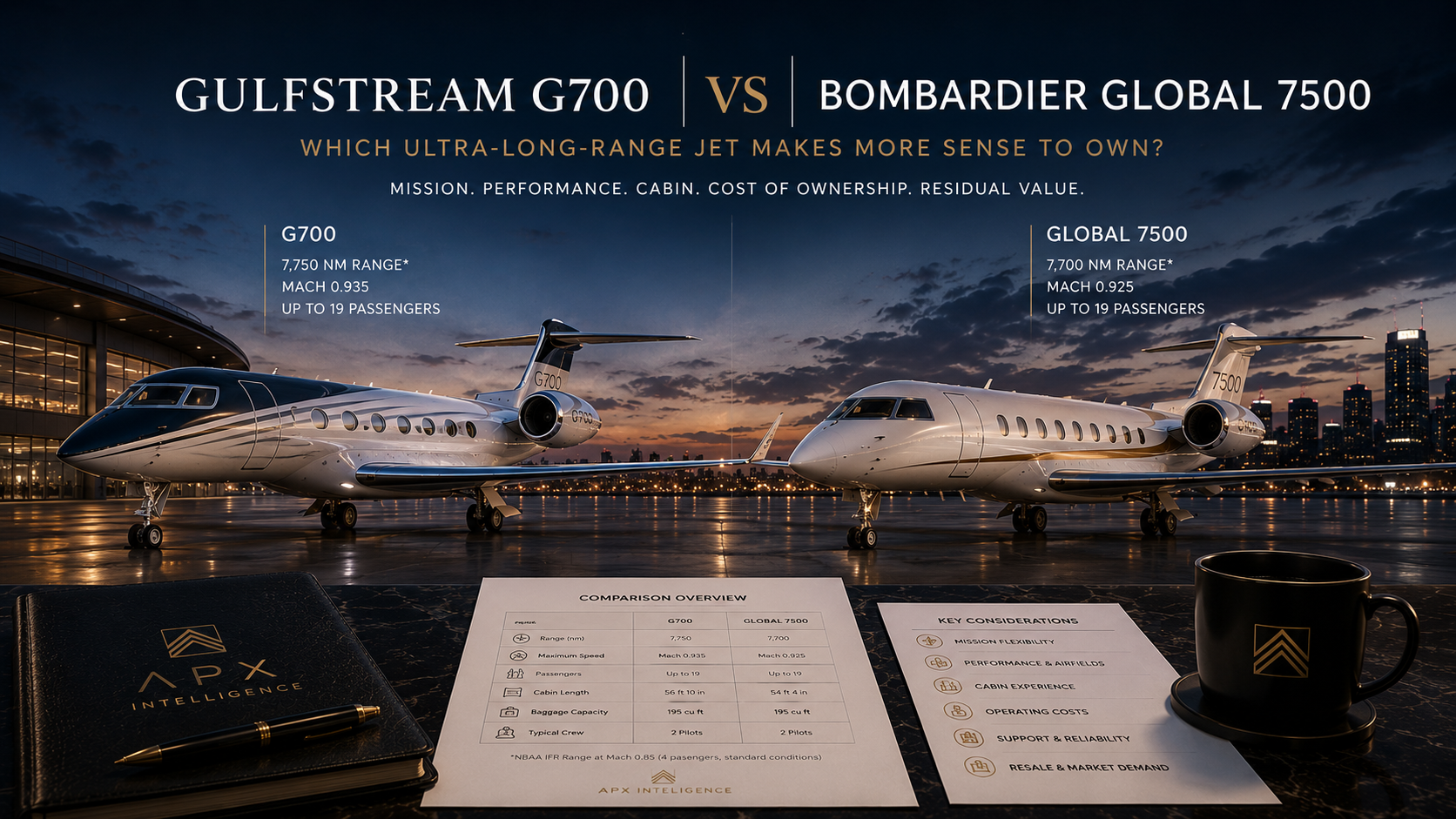
Gulfstream G700 vs Bombardier Global 7500: Which Ultra-Long-Range Jet Makes More Sense to Own?
An institutional evaluation for principals, family offices, and corporate flight departments comparing mission profiles, cabin zoning, operating economics, and residual value mechanics.
Executive Summary
At the highest end of business aviation, purchasing an aircraft is rarely about deciding whether a private jet can fly from London to New York. The more relevant question is whether it can repeatedly move principals, family members and executives between distant global centres without forcing the owner to compromise on time, cabin environment or operational flexibility. The Gulfstream G700 and Bombardier Global 7500 occupy precisely this territory. On headline performance, remarkably little separates them. Gulfstream publishes a maximum G700 range of 7,750 nautical miles, while Bombardier specifies 7,700 nm for the Global 7500. Both accommodate up to 19 passengers. Gulfstream's published maximum operating Mach is 0.935; Bombardier specifies Mach 0.925 for the Global 7500. Those numbers make an easy comparison. They do not make an acquisition decision. For an owner deploying tens of millions of dollars into a flagship aircraft, the more sophisticated comparison involves mission profile, cabin utilisation, airport requirements, maintenance support, operating philosophy, specification, residual value and the aircraft's eventual exit market. The correct question is therefore not: "Which aircraft is better?" It is: "Which aircraft better fits the way its owner actually travels?"
Key Takeaways
- Mission-First Selection: Acquisition decisions must be driven by actual recurring city pairs and payload requirements rather than theoretical brochure specifications.
- Marginal Range Delta: The headline 50-nautical-mile difference (7,750 nm vs 7,700 nm) is negligible under real-world headwinds, payload variations, and reserve fuel policies.
- Speed as a Strategic Asset: Higher cruise speeds (Mach 0.90 to 0.935) reduce total annual airframe hours, extending maintenance inspection intervals and lowering crew fatigue.
- Cabin Architecture & Zoning: The G700's potential 5-living-zone configuration provides superior activity isolation, while the Global 7500's 4-zone layout emphasizes wing flex and seating comfort.
- Total Cost of Ownership: Acquisition price is merely the entry fee; annual hours (250 vs 400 vs 600+) dictate the fixed versus variable operating cost equation.
- Fleet Commonality: Flight department familiarity with Gulfstream's Symmetry or Bombardier's Vision avionics creates significant operational and crew retention synergies.
- Exit Market Liquidity: Interior specification, maintenance program enrollments, and neutral color schemes directly govern secondary market residual values.
At a Glance: Head-to-Head Specifications
| Performance & Structural Vector | Gulfstream G700 | Bombardier Global 7500 |
|---|---|---|
| Published Maximum Range | 7,750 nm | 7,700 nm |
| Maximum Operating Speed (MMO) | Mach 0.935 | Mach 0.925 |
| Maximum Passenger Capacity | Up to 19 | Up to 19 |
| Maximum Operating Altitude | 51,000 ft | 51,000 ft |
| Maximum Take-Off Weight (MTOW) | 107,600 lb | 114,850 lb |
| Engine Architecture | Rolls-Royce Pearl 700 | GE Passport |
| Living Area Zones | Up to 5 Living Areas | Up to 4 Living Areas |
Manufacturer figures use specified test assumptions; actual performance varies with payload, weather, routing, configuration and operating conditions.
1. Start With the Mission, Not the Aircraft
This sounds obvious. It frequently isn't.
An aircraft acquisition can become emotional surprisingly quickly. Cabin finishes, brand loyalty, exterior design and the appeal of owning the latest flagship can begin influencing the decision before anyone has properly analysed the owner's actual travel.
A professional acquisition process should begin with historical and expected missions:
- Where does the principal travel?
- How often?
- With how many passengers?
- How much baggage?
- Are flights predominantly eight hours—or fifteen?
- Are destinations major international airports or smaller regional fields?
- Does the principal routinely travel overnight?
- Will crew rest facilities be important?
- Will the aircraft frequently reposition empty?
Only after answering those questions does a meaningful G700-versus-Global-7500 comparison begin.
2. Range: 7,750 vs 7,700 Nautical Miles
This is where specification-sheet comparisons can become misleading.
Gulfstream currently publishes a G700 maximum range of 7,750 nm at Mach 0.85, while also advertising up to 6,650 nm at Mach 0.90. Bombardier publishes 7,700 nm for the Global 7500 under its stated theoretical conditions at Mach 0.85.
A 50-nautical-mile headline difference should not determine an acquisition of this magnitude. Real-world range changes with:
- passenger load;
- baggage;
- winds;
- temperature;
- routing;
- reserves;
- airport elevation;
- aircraft specification;
- and cruise strategy.
The better analysis asks whether the owner's actual recurring city pairs can be operated reliably under realistic conditions. A theoretical maximum range is useful. A mission analysis is useful to the owner.
3. Speed: When Minutes Become an Ownership Variable
At this level, speed deserves more attention than it might initially appear to warrant.
The G700's published maximum operating speed is Mach 0.935. Bombardier specifies Mach 0.925 as the Global 7500's top speed. Again, the headline difference is small.
But owners of ultra-long-range aircraft often purchase precisely because their time has exceptional economic value.
Gulfstream explicitly makes another interesting ownership argument: operating at Mach 0.90 can reduce flight hours, potentially increasing intervals between scheduled maintenance events while reducing crew time.
That illustrates an important principle: Speed isn't merely performance. It can influence aircraft utilisation.
For a principal flying several hundred hours annually, small efficiencies repeated over years become more meaningful.
4. The Cabin Is Where the Decision Becomes Personal
Performance can be measured. Cabin preference cannot.
Gulfstream specifies a finished G700 cabin measuring approximately 6 ft 3 in high and 8 ft 2 in wide, with up to five living areas, 20 panoramic oval windows and seating for up to 19. Gulfstream also publishes a cabin altitude of 2,840 ft when the aircraft is flying at 41,000 ft.
At this level, however, dimensions alone miss the point. The aircraft may simultaneously need to function as:
- bedroom;
- boardroom;
- dining room;
- communications centre;
- private lounge;
- and crew workplace.
A principal routinely completing overnight intercontinental missions may place extraordinary value on separation between sleeping, working and communal areas. Another owner may prioritise larger group travel. Another may routinely travel with children. Another might require highly private working areas separated from guests.
There is no universally superior cabin. There is a superior cabin for a particular mission.
5. Five Living Areas Can Matter More Than 50 Nautical Miles
This is why I would avoid making the article a specifications contest.
Gulfstream's ability to configure the G700 with up to five living areas creates possibilities around how different zones are used during a long flight. Imagine a 13-hour mission:
$$\text{Zone 1: Work} \longrightarrow \text{Zone 2: Dining} \longrightarrow \text{Zone 3: Conference} \longrightarrow \text{Zone 4: Entertainment} \longrightarrow \text{Zone 5: Master Suite}$$
The value of a large-cabin aircraft is not simply that everyone fits inside. It's that different activities can occur simultaneously without everyone occupying the same environment.
For an UHNW family or global executive, that can be more important than a marginal difference in theoretical range.
6. Airport Performance Changes the Network
Ultra-long-range capability is only useful if the aircraft can operate effectively from the airports the owner wants to use.
Runway length, temperature, elevation, weather and payload all influence performance. This becomes particularly important for owners travelling to:
- island destinations;
- mountain airports;
- regional business centres;
- secondary airports;
- or locations where runway performance is constrained.
The aircraft that theoretically flies farther may not necessarily be the aircraft that provides the greatest practical network flexibility for a particular owner.
Before acquisition, the flight department shouldActionably model frequent destinations under realistic seasonal conditions—not just the glamorous ones, but the awkward ones.
7. The Purchase Price Is Only the Admission Fee
For aircraft at this level, focusing entirely on acquisition cost is a mistake. Ownership introduces an ongoing financial ecosystem.
| Cost Component | Operational Rationale & Financial Impact |
|---|---|
| Flight Crew & Cabin Personnel | Captains, first officers, recurrent training, benefits, and dedicated long-haul cabin crew. |
| Fuel Expenditure | The largest variable operating cost; highly dependent on cruise Mach speed and payload. |
| Maintenance & Engine Programs | Hourly coverage schemes (e.g., Rolls-Royce CorporateCare, GE OnPoint) essential for resale value. |
| Hangarage & Insurance | Base airport fees at capacity-constrained hubs plus hull and liability insurance. |
| Management & Connectivity | Third-party management fees plus high-speed Ka-band/Ku-band global satellite internet. |
The true question isn't: What does the G700 cost? It's: What will our G700 cost given the way we intend to operate it? The same applies to the Global 7500.
8. 250 Hours, 400 Hours or 600 Hours?
Aircraft economics change drastically with annual utilisation:
- 250 Hours Per Year: Fixed costs are spread across relatively few flight hours. The convenience of ownership is substantial, but the economic case against charter or fractional alternatives deserves careful scrutiny.
- 400 Hours Per Year: The aircraft becomes a heavily utilised business and mobility asset. Ownership economics begin to look quite rational.
- 600 Hours Per Year: Operational capability becomes critical. Crew scheduling, maintenance planning and aircraft availability become paramount.
High utilisation can justify whole ownership while simultaneously increasing the sophistication required to operate the airframe efficiently. Annual hours are therefore one of the first numbers an acquisition adviser should establish.
9. Maintenance: Don't Compare Only the Bills
Maintenance economics are more nuanced than asking which aircraft costs less to service. An owner should consider:
- scheduled inspection intervals;
- engine coverage;
- parts availability;
- geographic service-centre coverage;
- mobile support;
- unscheduled downtime;
- warranty;
- replacement aircraft arrangements;
- and maintenance planning around the owner's travel calendar.
Bombardier emphasises its global support network, including company-owned parts depots, service centres and 24/7 customer response capability. Gulfstream similarly positions high-speed utilisation partly around reducing accumulated flight hours between scheduled maintenance visits.
For an owner, availability can matter more than the lowest theoretical maintenance cost. A cheaper aircraft sitting in maintenance when the principal needs to fly is not delivering value.
10. Crew Preference Matters More Than Buyers Sometimes Expect
Pilots are not interchangeable inputs. Aircraft type experience matters, training availability matters, and recruitment markets matter. So does culture.
Some flight departments have longstanding Gulfstream experience. Others have operated Bombardier aircraft for years. Changing manufacturer can introduce:
- new training;
- new procedures;
- different maintenance relationships;
- different supplier networks;
- and potentially different staffing requirements.
If an existing flight department already operates aircraft from one manufacturer, fleet commonality deserves serious consideration. The aircraft does not operate independently of the organisation around it.
11. Specification Can Determine Resale
Two examples of the same aircraft can eventually have very different secondary-market appeal. Why? Specification.
Future buyers care about cabin layout, connectivity, entertainment systems, galley configuration, crew rest, colour schemes, maintenance status, programme enrolment, avionics options, paint, total time, damage history, and ownership provenance.
Highly personalised interiors can be magnificent for the commissioning owner. They can also narrow the future buyer pool.
That doesn't mean owners should avoid personalisation. It means they should understand its possible residual-value consequence.
12. Residual Value: Think About the Sale Before the Purchase
An aircraft acquisition has two transactions: the purchase, and eventually, the disposal. Sophisticated buyers think about both on day one. Future residual value is governed by:
| Value Driver | Impact on Secondary Market Liquidity |
|---|---|
| Installed Fleet Size | Larger active fleets ensure robust secondary demand, parts liquidity, and charter placement. |
| Maintenance Program Enrolment | 100% engine and APU coverage (e.g., CorporateCare) is mandatory for top-tier pricing. |
| Interior Neutrality | Universally appealing 4/5-zone floor plans sell faster than highly customized niche layouts. |
Neither a Gulfstream nor a Bombardier badge removes depreciation risk. Large business jets are capital assets with technological and market cycles. The sensible acquisition question is therefore: What will the next buyer want from this aircraft?
13. Charter Revenue: Helpful, But Don't Build the Thesis Around It
Some owners consider making their aircraft available for third-party charter when they are not using it to offset a portion of fixed ownership costs.
But it introduces trade-offs. Commercial operation increases flight hours, cycles, cabin wear, crew workload, scheduling complexity, maintenance, and regulatory obligations.
There is also the fundamental availability question: If a principal purchases a flagship aircraft for absolute mobility, do they really want it halfway across Europe carrying charter passengers when their plans suddenly change?
Charter can be financially useful. It should not automatically be assumed to make ownership "pay for itself."
14. Global 7500: Where the Case Is Strong
The Global 7500 has an established position in the ultra-long-range segment and combines 7,700 nm of published range with seating for up to 19 passengers and GE Passport propulsion.
For some buyers, that established operating history itself may be attractive. The aircraft may particularly appeal where:
- the principal already operates Bombardier aircraft;
- the flight department values fleet continuity;
- the desired cabin configuration suits the owner's mission;
- existing Bombardier support relationships are strong;
- or a suitable aircraft becomes available on commercially compelling terms.
And that last point matters. Theoretical comparison is not the same as transaction comparison. A perfectly specified Global 7500 available at the right time may be more attractive than waiting for a different aircraft simply because a specification table favours it marginally.
15. G700: Where the Case Is Strong
The G700 combines Gulfstream's current large-cabin architecture with up to five living areas, a 7,750 nm published maximum range and maximum operating speed of Mach 0.935. It uses two Rolls-Royce Pearl 700 engines.
Its proposition can be particularly compelling where:
- cabin zoning is important;
- the owner values Gulfstream fleet continuity;
- high-speed long-range travel is central to the mission;
- the owner wants a current-generation flagship;
- or the configuration strongly matches family or corporate requirements.
But again, none of these automatically makes it the correct purchase. Aircraft acquisition is ultimately about fit.
16. What About the Gulfstream G800?
This is an important question because a buyer considering the G700 may also examine Gulfstream's G800.
The G800 uses the same Rolls-Royce Pearl 700 engine family and Gulfstream's Symmetry Flight Deck, but its cabin is shorter than the G700's and provides up to four living areas rather than five.
That illustrates the fundamental trade-off beautifully: An owner might prioritise maximum cabin flexibility, while another may place greater weight on extreme mission range capability. Once again, there isn't one "best" aircraft; there is an aircraft optimised around the owner's priorities.
17. The APX Ownership Test
Before choosing either aircraft, APX would reduce the decision to ten fundamental questions:
- 1. What are the owner's ten most frequent city pairs?
- 2. How many passengers normally travel?
- 3. How many annual flight hours are genuinely expected?
- 4. How frequently are overnight sectors flown?
- 5. Which airports create performance constraints?
- 6. Is there an existing flight department?
- 7. Is Gulfstream or Bombardier fleet commonality relevant?
- 8. Will the aircraft ever be chartered?
- 9. How important is future resale liquidity?
- 10. What happens if the owner's travel pattern changes in five years?
Those answers will reveal vastly more than another twenty pages of specifications.
18. Frequently Asked Questions
Q: Which has greater range: Gulfstream G700 or Global 7500?
A: On current manufacturer figures, Gulfstream publishes a maximum theoretical range of 7,750 nm for the G700 versus Bombardier's 7,700 nm for the Global 7500 under their respective stated conditions. Actual range varies with operating circumstances.
Q: Which is faster?
A: Gulfstream publishes a maximum operating Mach of 0.935 for the G700, while Bombardier specifies a top speed of Mach 0.925 for the Global 7500.
Q: How many passengers can they carry?
A: Both manufacturers publish maximum seating capacity of up to 19 passengers, although actual configuration and mission requirements affect practical utilisation.
Q: Which has the better cabin?
A: That is subjective. Cabin layout should be evaluated around the owner's typical missions, passenger numbers, sleeping requirements, working patterns and privacy needs.
Q: Which aircraft costs less to own?
A: There is no meaningful universal answer. Annual utilisation, fuel prices, crew structure, maintenance programmes, base airport, management arrangements, financing and specification all materially affect ownership cost.
Q: Should an owner buy new or pre-owned?
A: That depends upon availability, pricing, delivery timing, specification and mission requirements. A well-specified pre-owned aircraft can sometimes represent a more rational acquisition than waiting for a new delivery.
19. Institutional Glossary
- Maximum Operating Speed (MMO)
- The absolute maximum velocity, measured in Mach number, at which an aircraft can be safely operated under normal flight operations.
- Nautical Miles Range (nm)
- The non-stop flight distance an aircraft can traverse under specific payload, wind, and fuel reserve criteria.
- Cabin Zoning & Living Areas
- The structural partitioning of a long-range business jet interior into distinct operational rooms for dining, sleeping, conferencing, or crew rest.
- Maximum Take-Off Weight (MTOW)
- The maximum certificated gross weight of an aircraft authorized for takeoff, influencing airport landing fees and runway requirements.
- Residual Value & Exit Liquidity
- The projected secondary-market appraisal value of an aircraft upon disposal, governed by flight hours, maintenance status, and interior configuration.
20. Institutional Verification & Operational Standards
For family office aviation leads, corporate flight departments, and aircraft buyers, acquisition benchmarks should be cross-referenced against established aviation regulatory frameworks:
| Governance Dimension | Governing Body / Aviation Regulatory Standard | Primary Standard & Verification Requirement |
|---|---|---|
| Type Certification & Safety | FAA / EASA Commercial Aviation Standards | Part 25 Transport Category Aircraft Airworthiness & Noise Certification. |
| Flight Operations & Management | IS-BAO / NBAA Best Practices | International Standard for Business Aircraft Operations (IS-BAO Stage I-III). |
| Aircraft Appraisal & Valuation | International Society of Transport Aircraft Trading (ISTAT) | Certified Aircraft Appraisal Standards for Residual Value & Asset Financing. |
21. The APX Perspective
At this end of aviation, specification differences become surprisingly small while ownership decisions become increasingly personal.
The G700 and Global 7500 are both extraordinary pieces of long-range transportation infrastructure. Choosing between them should therefore not become a contest over fifty nautical miles of theoretical range or a few thousandths of Mach.
For the sophisticated buyer, the aircraft is part of a much larger system:
$$\text{Principal} \rightarrow \text{Mission} \rightarrow \text{Crew} \rightarrow \text{Airport} \rightarrow \text{Support} \rightarrow \text{Operating Cost} \rightarrow \text{Availability} \rightarrow \text{Resale}$$
The best aircraft is the one that makes that system work most effectively. And that leads to perhaps the most important principle in private-aircraft acquisition:
Do not buy the aircraft capable of the most impressive mission. Buy the aircraft optimised for the missions you actually fly.


