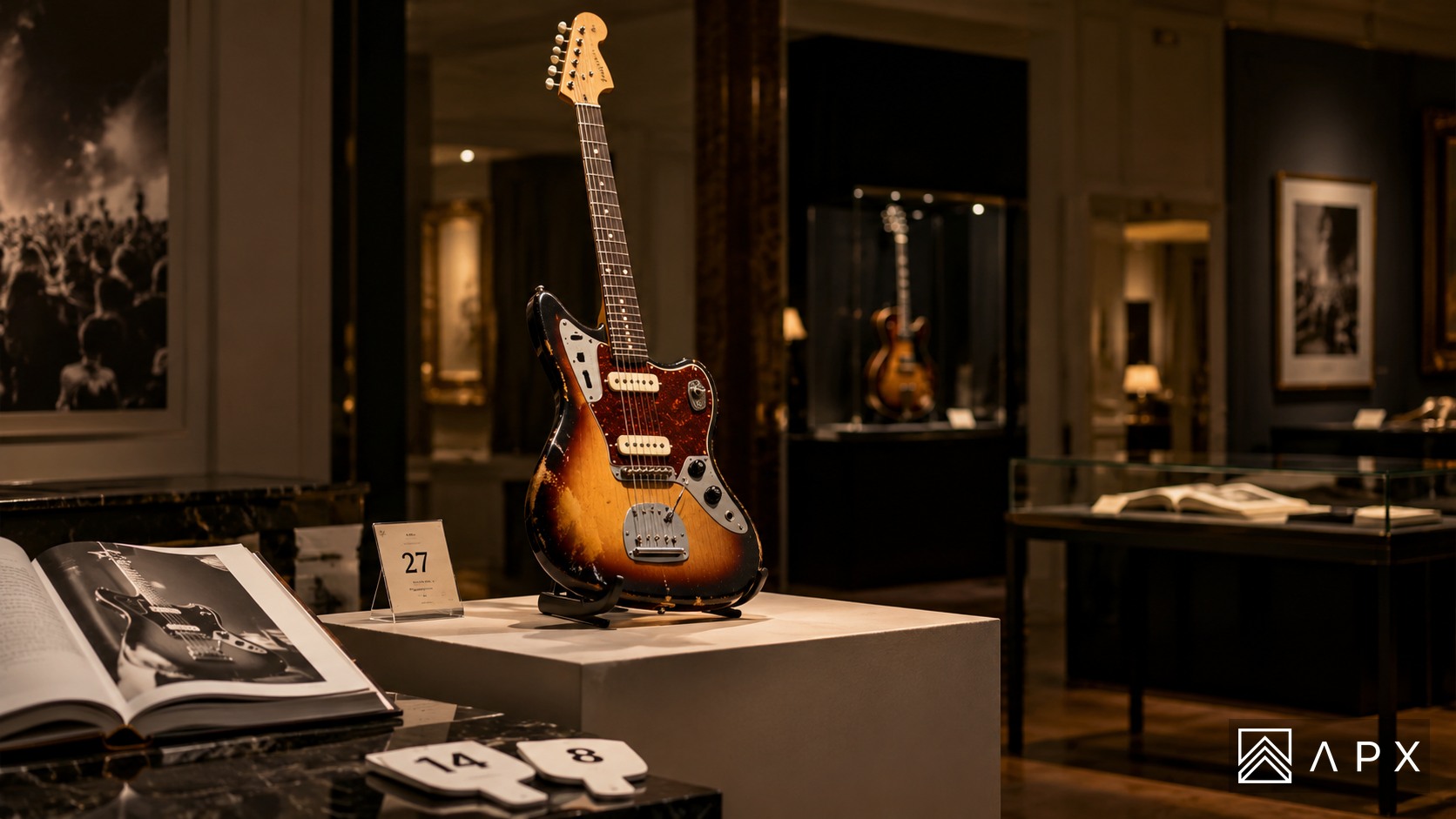
Johnny Marr’s £3.65m Christie’s sale shows how provenance, documented use and cultural relevance shape the value of important guitars.
Executive Summary
Christie’s September 2026 sale of Johnny Marr’s guitars turned a personal working archive into a global collector event. The 111-lot auction realised £3.649 million, more than triple its estimate, attracting registrants from 34 countries; Christie’s said 81% were new to the auction house. The result is a useful case study in how provenance, cultural relevance and documented use can transform an instrument from a valuable guitar into a piece of music history.
Key Takeaways
- Provenance drives the premium. Artist ownership alone is not enough; documented use on recordings, tours or defining moments can matter far more.
- Narrative must be evidenced. Photographs, studio records, certificates, serial numbers and auction cataloguing support the chain of attribution.
- The buyer pool is broader than musicians. High-end instruments increasingly sit alongside art, watches, cars and sports memorabilia in cross-category collections.
- Liquidity is selective. A famous name does not guarantee an easy resale; the strongest objects combine artist importance, recognisable use and scarcity.
- Condition and restoration still matter. Collector value depends on originality, documented modifications and whether changes form part of the instrument’s working history.
A £3.65 Million Signal from Christie’s
On 17 September 2026, Christie’s sold Marr’s Guitars: The Johnny Marr Collection in London for £3,649,280. The auction house reported that the result was more than three times the estimate and that the sale drew registrants from 34 countries. One of the most closely watched instruments — Marr’s 1982 Rickenbacker 330 Jetglo, strongly associated with his Smiths-era sound — sold for £358,400 against an estimate of £60,000–£80,000.
The significance is not simply the total. It is the way buyers valued direct connection to recorded culture. The collection included instruments used to write, record and perform material across Marr’s career, turning ordinary valuation metrics such as maker, year and specification into only the starting point.
Why Provenance Changes the Valuation
A production guitar can often be compared with similar examples. An artist-played instrument is different. Its value can derive from a chain of evidence connecting it to a person, period, song, recording session or public performance. That chain should be treated with the same discipline used for important art or historic automobiles.
Useful evidence can include serial numbers, artist photographs, stage images, studio logs, tour documentation, repair records, correspondence and prior auction catalogues. The strongest files do not rely on a single certificate; they build a consistent narrative from multiple independent sources.
The Music-Memorabilia Market Is Becoming More Institutional
Christie’s now operates a dedicated guitars category and in March 2026 sold the Jim Irsay Collection, which it described as the most valuable memorabilia auction in history. Sotheby’s has similarly published specialist guidance on provenance guitars. The direction is clear: iconic instruments are no longer treated only as fan memorabilia. At the top end, they are catalogued, insured, conserved and traded through the same infrastructure used for other significant collectibles.
That does not make every celebrity-owned object investment-grade. It does mean serious collectors should assess music assets with institutional discipline.
What Separates an Important Guitar from an Expensive Guitar?
Five questions are useful: Was the instrument central to a recognisable period of the artist’s work? Can that use be independently documented? Is the instrument visually or sonically identifiable? Is the artist’s cultural importance durable beyond the current fan cycle? And is the object scarce enough that another comparable example is unlikely to come to market soon?
The best objects answer all five. Lesser examples may still be desirable, but the buyer should understand whether the premium is driven by history, rarity, condition or simply proximity to a famous name.
Storage, Insurance and Display
A six-figure guitar remains a physical instrument. Wood moves, finishes react to light and temperature, metal corrodes and cases can trap moisture. A collector who intends to display an instrument should consider humidity, UV exposure, security, alarm integration and specialist insurance.
Playing the instrument creates another decision. Some collectors regard continued use as part of the object’s life; others prioritise conservation. Either approach should be documented, particularly if parts are changed or repair work is undertaken.
Exit Strategy and Auction Timing
The strongest music assets can generate extraordinary bidding when several motivated collectors meet in one sale, but that same concentration creates price volatility. Private sale, specialist auction and broader popular-culture sales can produce different outcomes. Sellers should consider estimate strategy, reserve, marketing, touring exhibitions, catalogue scholarship and whether the asset is stronger alone or as part of a coherent collection.
APX Perspective
The Marr sale shows why provenance is becoming a language shared across art, cars, watches, sport and music. A great guitar is not valuable because it has become financialised; it is valuable because a documented object can carry cultural history in a way a conventional financial asset cannot. For family offices and serious collectors, the opportunity is therefore less about chasing celebrity and more about identifying objects whose importance is understandable, provable and likely to remain relevant across generations.
Frequently Asked Questions
What did Johnny Marr’s Christie’s guitar collection sell for?
Christie’s reported a sale total of £3,649,280 for the 111-lot auction held in London on 17 September 2026.
What makes an artist-owned guitar more valuable?
Documented use, cultural significance, scarcity, condition and a strong provenance file can all increase collector demand.
Are musician-owned guitars guaranteed investments?
No. Prices can be highly selective and illiquid. Cultural relevance and provenance can support value, but resale outcomes are never guaranteed.
Related APX Intelligence
Sources & Further Reading
APX Intelligence is provided for general informational purposes only and does not constitute investment, valuation, tax, legal or insurance advice. Collectibles can be illiquid and values may fall as well as rise.