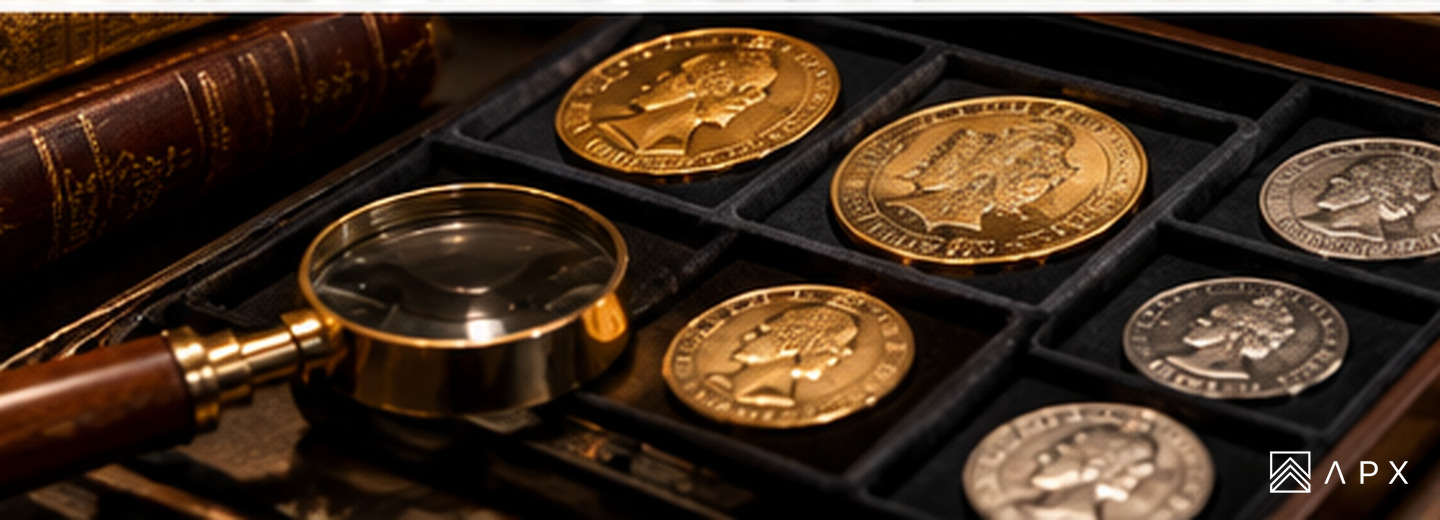
A rare 1879 Quintuple Stella sold for $2.562 million in 2026. APX examines grading, population scarcity, provenance and custody in trophy numismatics.
Executive Summary
Rare coins combine one of the oldest collecting traditions with one of the most sophisticated modern grading infrastructures. In September 2026, Heritage Auctions sold the finest-certified 1879 Liberty Head Quintuple Stella pattern for $2.562 million. The coin was described as one of only five traced examples, with one held by the Smithsonian and four in private hands.
For UHNW collectors, numismatics offers unusually deep price archives, certification data and international buyer networks. But the apparent transparency can be deceptive. A one-point grade difference, surface designation, provenance or variety can shift value by hundreds of thousands of dollars. Buyers need to understand the specific coin, not merely the date and denomination.
Key Takeaways
- Heritage’s 2026 ANA U.S. Coins auction was led by a $2.562 million Quintuple Stella pattern.
- The same ANA events generated tens of millions of dollars across U.S., world and ancient coins, demonstrating substantial market depth.
- Third-party grading and population reports provide more standardisation than many alternative-asset categories.
- The finest-known or finest-certified examples can command exponential premiums over lower-grade coins.
- Counterfeits, altered surfaces, cleaning, artificial toning and provenance gaps remain material risks.
Why Rare Coins Work as a High-End Collectible
Coins are compact, globally recognised and relatively easy to store. They also have a long scholarship tradition: mintages, dies, varieties and pedigrees have been studied for generations. That creates a research base that many newer collectible markets lack.
The trophy end is usually driven by one of three things: extraordinary rarity, exceptional grade or historical significance. Pattern coins such as the Quintuple Stella can combine all three because they were experimental objects produced in tiny numbers rather than ordinary circulation issues.
The Grade Premium
A common misunderstanding is that two coins of the same type should trade at similar levels. In reality, collectors may pay a dramatic premium for the finest certified example because there may be no substitute. Registry-set competition, institutional-quality collections and the prestige of owning the best known can create a steep value curve at the top.
Grade is not purely numerical either. Eye appeal, strike, toning, surface quality and cameo contrast can differentiate coins with the same headline grade. Certification helps standardise the market but does not remove the need for expert viewing.
Due Diligence and Custody
Certification numbers should be verified directly with the grading service, including photographs where available. Buyers should review prior auction appearances, pedigree, regrading history and any evidence of conservation. A coin that has upgraded several times may still be excellent, but the history should be understood.
Storage is efficient relative to art or cars, but security is crucial because coins are highly portable. Bank vaults, private vaulting, inventory controls and insurance schedules are common for high-value collections. Geographic diversification may be relevant for very large holdings.
Building a Collection Rather Than Buying Isolated Rarities
Numismatics rewards focus. Collections built around a denomination, mint, period, pattern series or historical theme can become more important than a sequence of unrelated expensive coins. A coherent collection also improves due diligence because the owner and advisers develop specialist knowledge in a narrow field.
Exit planning matters. The highest-value collections are often dispersed through carefully catalogued single-owner auctions, where the collector's name and scholarship become part of the provenance. That can create a stronger narrative than selling individual coins opportunistically.
APX Perspective
Rare coins are one of the more mature passion-asset markets. Their strength lies in scholarship, grading and compact custody; their weakness lies in extreme price sensitivity at the top of the grading curve. The highest-quality coins can be genuinely scarce, but buyers should resist treating every graded rarity as a financial asset. The most defensible acquisitions combine historical importance, true population scarcity and a strong chain of provenance.
Frequently Asked Questions
Does third-party grading make rare coins low risk?
No. It improves standardisation and authenticity confidence, but market demand, eye appeal, provenance, variety and grading risk still matter.
Why do pattern coins command such high prices?
Many were struck in tiny numbers for experimental or presentation purposes, creating extreme scarcity and strong historical interest.
Are rare coins easy to sell?
Major certified rarities can have deep auction demand, but specialist timing and buyer concentration still matter. Lesser material can be much less liquid.
Related APX Intelligence
Sources & Further Reading
APX Intelligence is provided for general information only and does not constitute investment, legal, tax or financial advice. Collectibles and alternative assets can be illiquid, difficult to value and subject to material transaction, storage, insurance and authenticity risk.