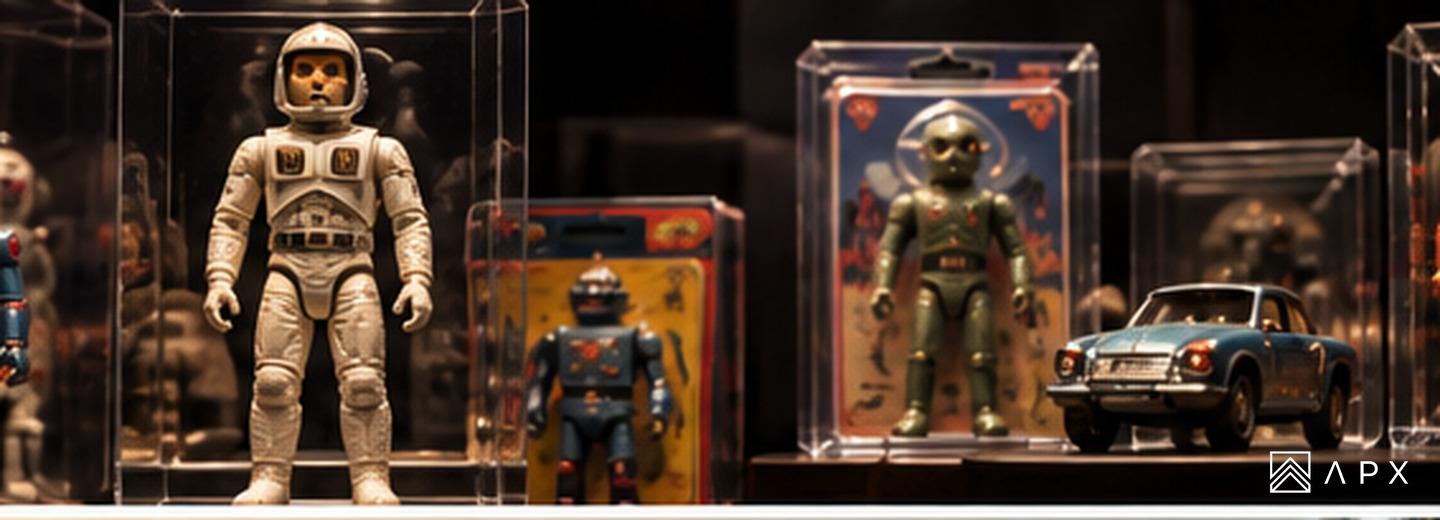
A $525,000 Boba Fett prototype shows how rare toys can cross into trophy-asset territory. We examine scarcity, grading, provenance and preservation.
Executive Summary
Vintage toys have produced one of the more surprising high-end collectible markets of the past decade. In May 2024, Heritage Auctions sold a hand-painted, rocket-firing Boba Fett prototype for $525,000, then a record for a vintage toy at auction. The figure stood just 3¾ inches tall and was never commercially released. Its value came from a combination of prototype status, extreme survival scarcity, Star Wars cultural significance and a well-developed authentication market.
The category has since broadened into production prototypes, sealed action figures, original packaging artwork, rare international variants, film-used props and franchise material. For family offices and serious collectors, toys are therefore best understood not as one homogeneous market but as a set of highly specialised sub-markets where documentation and condition can be more important than age.
Key Takeaways
- A hand-painted Kenner rocket-firing Boba Fett prototype sold for $525,000 in 2024.
- Prototype and pre-production material can command a very different valuation framework from ordinary retail toys.
- Sealed condition, original packaging, factory provenance and population scarcity are central value drivers.
- Franchise strength matters: Star Wars, early Barbie, selected Japanese tin toys and culturally important prototypes attract deeper international demand than most vintage toy categories.
- Counterfeits, reproduction packaging and component swapping make specialist authentication essential.
Why a Toy Can Be Worth More Than a House
At the trophy end, collectors are often buying a piece of design and entertainment history rather than the toy itself. The rocket-firing Boba Fett is a strong example. Kenner developed the missile feature but did not release it to consumers, meaning the surviving prototypes represent a moment that exists in collecting lore but not in ordinary retail history. That combination of cancelled production, recognisable character and tiny surviving population creates a form of scarcity that cannot be recreated by simply making fewer modern collectibles.
The same logic applies to first-shot figures, engineering pilots, hand-painted samples, unreleased packaging and objects linked to a designer, actor or production archive. These objects can sit closer to industrial design prototypes or film memorabilia than conventional toys.
Where the Value Is Concentrated
Prototypes and unreleased objects
Prototype material is attractive because supply is naturally limited and often tied to the development history of a major franchise. But documentation is critical. A prototype without credible factory provenance may simply be an unusual loose figure.
Sealed and high-grade production examples
For mass-market action figures, packaging condition can dominate value. Creases, cracked bubbles, resealing, edge wear, sun fading and replaced accessories can dramatically affect grade. Third-party population reports are increasingly important because a nominally common figure can be exceptionally scarce in top sealed condition.
Original packaging and production art
The category extends beyond physical toys. Original cardback artwork, concept drawings, sculpting masters and advertising material can provide a more unique route into a franchise and may be less vulnerable to the population inflation that affects production objects.
Due Diligence
For a six-figure toy acquisition, insist on a full object history. Confirm whether components were factory-issued together, whether packaging has been opened or restored, whether paint is original, whether accessories are authentic and whether any grading holder can be matched to the certification database. High-value Star Wars material in particular has enough demand to attract sophisticated fakes.
Storage also needs more thought than the object's size suggests. Plastic can yellow, blister packs can crack, adhesives can fail and printed card can fade. Stable temperature, low ultraviolet exposure and appropriate humidity are important if the objective is multi-decade preservation.
APX Perspective
Vintage toys are a compelling example of niche assets becoming globally legible through grading, auction archives and online bidder networks. The investable segment remains exceptionally selective. A $525,000 Boba Fett does not imply that ordinary boxed toys are institutional assets. The premium belongs to objects that combine cultural importance, scarcity, recognisable provenance and condition at the top of the known population.
Frequently Asked Questions
Are unopened toys always more valuable?
Often, but not automatically. Factory seals, packaging condition, production variation and rarity all matter. A rare prototype without retail packaging can be far more valuable than a sealed production toy.
What is the biggest risk in high-value toy collecting?
Authentication. Reproduction cardbacks, resealed bubbles, replaced accessories and undocumented prototype claims can materially alter value.
Can toys be insured like art?
Specialist collectibles insurers can cover high-value toys, but schedules, professional valuations, secure storage and photographic records are usually required.
Related APX Intelligence
Sources & Further Reading
APX Intelligence is provided for general information only and does not constitute investment, legal, tax or financial advice. Collectibles and alternative assets can be illiquid, difficult to value and subject to material transaction, storage, insurance and authenticity risk.