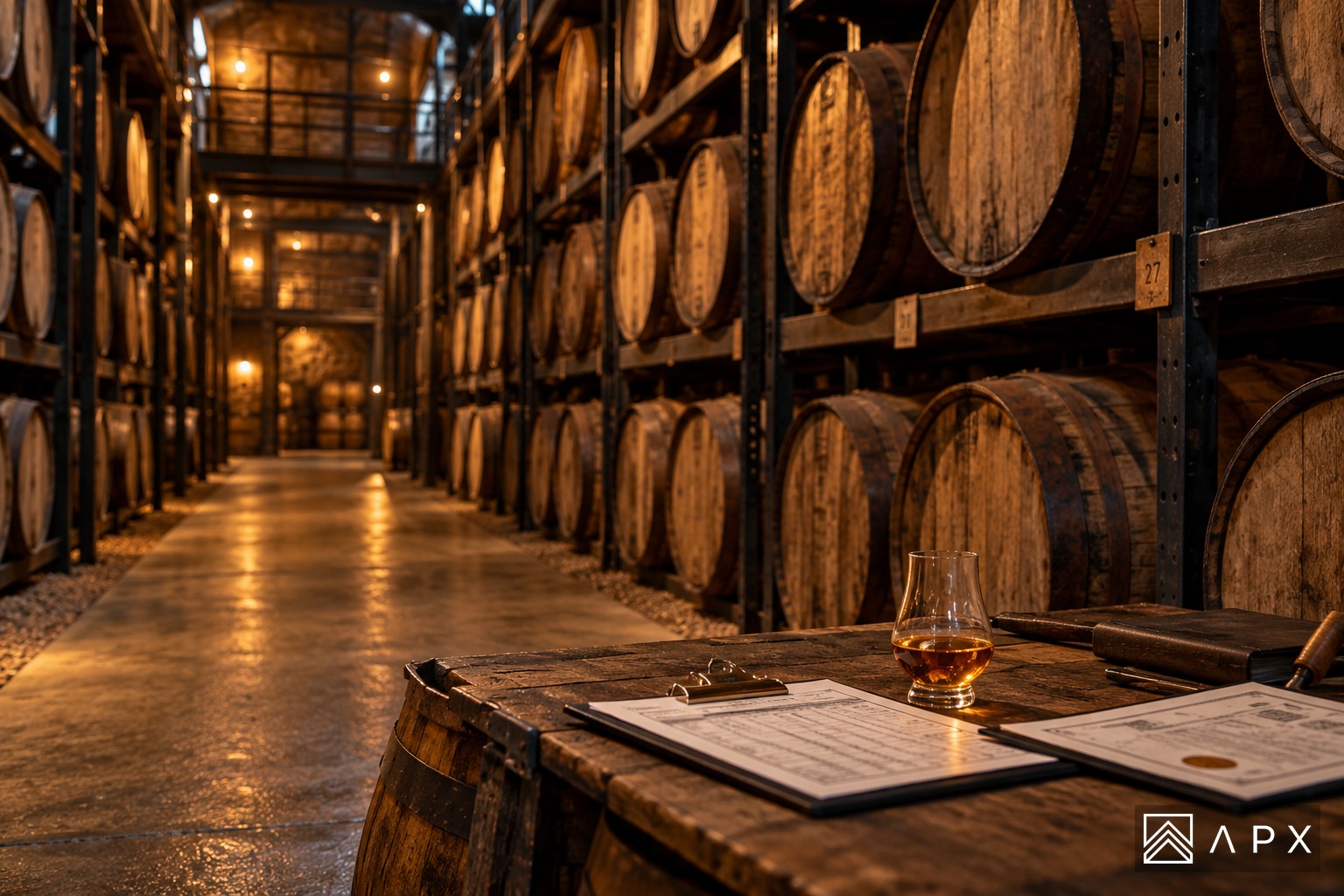
Whisky cask value depends on more than age and distillery. APX examines legal title, warehouse records, insurance, evaporation and realistic exit routes.
Executive Summary
Whisky cask ownership is often marketed around age, distillery and projected appreciation, but the operational asset is a cask sitting in a regulated warehouse. Legal title, warehouse acknowledgement, insurance, evaporation, alcoholic strength, movement restrictions and exit options can matter as much as the spirit itself. The Scotch Whisky Association explicitly warns that there is no regulated open market or official published price list for casks.
Key Takeaways
- Title must be evidenced. A contract of sale should identify the spirit, cask number, volume and warehouse.
- The warehouse should recognise the owner. Ownership recorded only by the seller can create avoidable risk.
- Storage is regulated. Scotch Whisky must mature in approved premises in Scotland, and duty-suspended movements are controlled.
- Evaporation is certain; appreciation is not. The SWA notes that a cask loses roughly 2% of its contents annually through evaporation.
- Exit is not automatic. Bottling, resale, movement, branding restrictions, tax and buyer demand can all affect realisable value.
The Cask Is a Physical Asset Before It Is an Investment
The Scotch Whisky Association says there is no regulated market for mature or maturing casks, no official list of buying and selling prices and no established mechanism equivalent to an exchange. That makes due diligence on ownership and exit particularly important.
A family office should begin with what actually exists: a defined cask of spirit, in a named warehouse, under a contract with specific rights.
Legal Title and Warehouse Acknowledgement
The SWA recommends obtaining a contract of sale that identifies the whisky type, distillery, distillation year, cask number, cask type, volume and warehouse. It also strongly recommends ensuring the warehousekeeper records and acknowledges the new owner.
This distinction is critical. An invoice from a seller may evidence a transaction, but the warehouse’s records determine who it recognises when movement, sampling or transfer instructions are received.
Approved Warehousing and Duty Suspension
Scotch Whisky must mature in approved premises in Scotland. HMRC guidance explains that excise goods can be held in duty suspension in approved excise warehouses, subject to the relevant authorisations. Buyers should identify the warehouse and warehousekeeper before purchase and understand the procedure for ownership changes and movements.
Storage, Insurance and the Angel’s Share
Storage and insurance are recurring costs. The SWA also notes that the only certainty about owning a cask is evaporation — roughly 2% of contents per year. Alcoholic strength also falls over time; if it drops below the legal minimum required for Scotch Whisky bottling, the asset’s options change materially.
Insurance should be tested for risks such as leakage, fire and physical damage rather than assumed from a generic warehouse statement.
Branding and Bottling Restrictions
Distillery names are often protected trademarks and sale contracts may restrict how the name can be used if the cask is later bottled or sold. Some sellers also impose conditions on movement or bottling. These restrictions can affect exit value and should be understood before purchase rather than discovered at sale.
Exit Planning
Possible exits include sale of the cask, sale back through a broker, private transfer or bottling. Each has costs and constraints. Bottling creates duty, VAT, packaging, logistics and minimum-run questions; resale depends on finding a willing buyer and may involve a substantial spread between indicative valuation and executable price.
A Cask Due-Diligence Checklist
- Distillery, spirit type and year independently verified.
- Cask number, cask type and current volume documented.
- Warehouse and warehousekeeper identified.
- Ownership acknowledged by the warehouse.
- Insurance scope confirmed.
- Sampling and regauging rights understood.
- Movement and bottling restrictions reviewed.
- Trademark/name-use restrictions reviewed.
- Exit route identified before purchase.
- All projected returns treated as scenarios rather than promises.
APX Perspective
Whisky cask investment is often presented as a story about scarcity and time. For a family office, it should first be a story about title and control. If the owner cannot prove what it owns, where it is stored, who recognises the ownership and how the asset can be moved or sold, the investment thesis is incomplete regardless of the distillery name.
Frequently Asked Questions
Is there an official market price for Scotch Whisky casks?
No. The Scotch Whisky Association states that there is no regulated open market or official published price list for casks.
How should ownership of a whisky cask be recorded?
The sale contract should identify the cask, and the warehousekeeper should acknowledge and record the buyer as owner using the documentation it requires.
Do whisky casks lose volume while ageing?
Yes. The Scotch Whisky Association notes that casks lose roughly 2% of their contents each year through evaporation, although actual rates vary.
Related APX Intelligence
Sources & Further Reading
APX Intelligence is provided for general informational purposes only and does not constitute investment, tax, legal or valuation advice. Whisky casks are illiquid physical assets and projected returns are not guaranteed.